European Court Rules Spain Violated Jehovah's Witness's Rights Over Forced Blood Transfusions
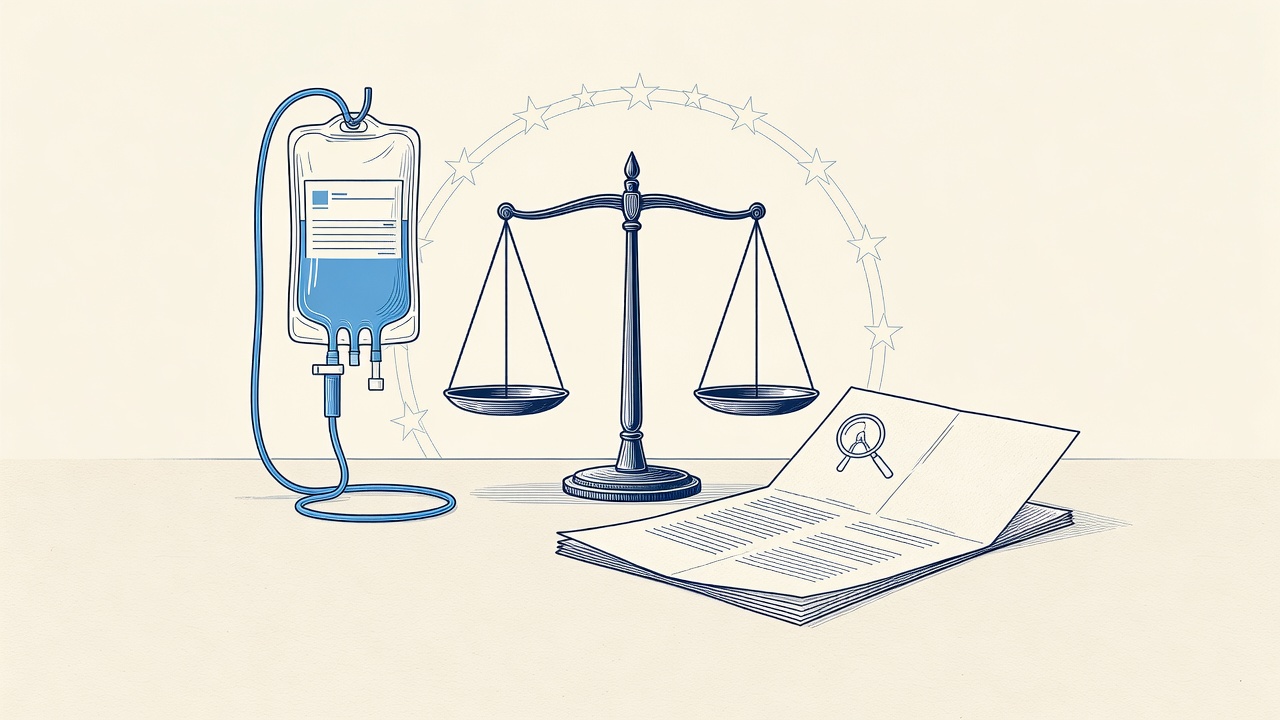
In Pindo Mulla v. Spain, the ECHR Grand Chamber unanimously found that Spain breached Rosa Edelmira Pindo Mulla's rights when a duty judge authorized three transfusions during emergency surgery despite her advance written refusals. The Court faulted the decision-making process, not the doctors' medical judgment.
On 17 September 2024, the Grand Chamber of the European Court of Human Rights ruled that Spain violated the rights of Rosa Edelmira Pindo Mulla, a Jehovah's Witness who received three blood transfusions during emergency surgery despite advance written refusals on religious grounds.[1]
The Court held unanimously that Spain breached Article 8 of the European Convention on Human Rights — the right to respect for private and family life — read in the light of Article 9, freedom of thought, conscience and religion.[1] All 17 judges agreed there had been a violation. The Court divided only later, and only on money: by 9 votes to 8, it awarded Pindo Mulla 12,000 euros for non-pecuniary damage.[1]
The ruling faulted the process by which Spanish authorities overrode her documented wishes — not the medical judgment of the doctors who treated her. The Court was explicit that its task was "not to call into question the assessment of Ms Pindo Mulla's health by medical professionals or their decisions on the treatment to be given," but to examine "whether the decision-making process had shown sufficient respect for her autonomy."[1]
Who the applicant is
Rosa Edelmira Pindo Mulla is an Ecuadorian national, born in 1970 and resident in Soria, Spain. She is a Jehovah's Witness.[1] Under the Convention, the party who brings a case is the "applicant"; here the applicant is a named individual whose refusal of blood was recorded, repeatedly and in writing, before the emergency that put it to the test.
What happened
In 2017, following medical tests, Pindo Mulla was advised to have surgery. In July 2017 she signed two documents — an advance directive and a lasting power of attorney — each recording that she refused any blood transfusion in any healthcare situation "even if her life was in danger," while accepting any treatment that did not involve blood.[1]
She carried the power-of-attorney document on her person. The advance directive was deposited in the Register of Advance Directives of Castile and León, which Soria hospital could access electronically. Under Spanish law, a directive filed in a regional register is to be copied to the National Register of Advance Directives within seven days.[1]
On the evening of 6 June 2018, Pindo Mulla was admitted to Soria Hospital with serious internal bleeding that was causing severe anaemia. A doctor discussed a transfusion; she refused and, together with the doctor, signed an informed-consent refusal document that entered her Soria medical file.[1]
The next day, 7 June 2018, worsening haemorrhaging led to her transfer by ambulance to a hospital in Madrid known for treatments that avoid blood. She agreed to the transfer believing she could be treated without a transfusion, and was accompanied by a doctor carrying her records.[1]
During the transfer, the accompanying doctor warned Madrid that her condition was very serious. Madrid anaesthesiologists then contacted the duty judge. According to the Court, they told the judge she was a Jehovah's Witness, that she had "verbally" refused "all types of treatment," and that she would be very unstable on arrival.[1]
About an hour later, the duty judge — who did not know the patient's identity or her precise wishes — consulted a forensic (medico-legal) doctor and the local prosecutor, then authorised all the medical or surgical procedures needed to save her life.[1]
Treated as an emergency, the normal consent protocol was skipped. Surgery was performed and three transfusions of red blood cells were administered. Hospital records noted she was "conscious, orientated and cooperative" on arrival and still "fully conscious" when taken to the operating theatre. Because no one told her of the judge's order — and because she believed she was being treated without blood — she did not repeat her refusal. She learned of the surgery and the transfusions the day after the operation.[1]
The procedural breakdown the Court identified
The Court's finding turned on what the duty judge was told, and what the judge was not told.
The request sent to the judge said Pindo Mulla had rejected "all types of treatment" — an overbroad description, because she had in fact accepted any non-blood treatment. It also described her refusal as merely "verbal," when it existed in multiple written forms: the registered advance directive, the power of attorney she carried, and the signed refusal form in her Soria file.[1]
In the Court's words, the judge's decision "had been based on very limited, incorrect and incomplete facts," and "the lack of information in the fax had had a determinative effect on the decision-making by the duty judge."[1] The authorisation, the Court said, had resulted from a process "affected by the omission of essential information about the documenting of Ms Pindo Mulla's wishes, which had been recorded in various forms and at various times in writing."[1]
Because neither the applicant nor anyone connected to her was told of the judge's authorising order, the omission could not be rectified — and, the Court found, neither the omission nor the question of her decision-making capacity was addressed adequately on appeal. The capacity question was "sidelined," and decision-making power was effectively "transferred to the doctors treating her." A missing signature on the copy of the Soria refusal form obtained for the appeal became "a central issue, yet it had remained unelucidated."[1] The conclusion: "The national system had therefore not responded adequately to Ms Pindo Mulla's complaint that her wishes had been wrongly overruled."[1]
The autonomy principle — and its limits
The Court restated as "a basic and fundamental principle" that a competent adult patient is free to decide whether to accept surgery or treatment, including a blood transfusion, protected by the rule of free and informed consent.[1]
But it also set out the counterweight. A refusal of life-saving treatment must be "clear, specific and unambiguous" and must "represent the current position of the patient." Where there is reasonable doubt, clinicians must make "every reasonable effort" to determine the patient's wishes; if they still cannot, they must protect life by providing essential care.[1] The ruling therefore preserves a life-preservation default when a patient's wishes cannot be clearly established. The Court also stressed that when a State sets up a system of advance directives that patients rely on, "it was important that the system functioned effectively" — and the violation flowed from the malfunction of Spain's own machinery, not from the emergency itself.[1]
The case was heard by a Grand Chamber of 17 judges under President Síofra O'Leary of Ireland; Spain's judge on the bench was María Elósegui.[1] Beneath the unanimous violation finding, the Court was visibly divided: several separate opinions were filed, and the bench split 9–8 on the damages award, with an eight-judge bloc led by Judge Anja Seibert-Fohr partly concurring and partly dissenting.[1]
Background: the Witnesses' blood doctrine
Jehovah's Witnesses refuse blood transfusions on scriptural grounds. As the religion states its position, the doctrine rests on passages read as commands to "abstain from blood" — among them Genesis 9:4, Leviticus 17:10–14, Deuteronomy 12:23, and Acts 15:28–29. Witnesses treat blood as sacred and as representing life, and read the apostolic decree in Acts as binding on Christians.[2]
According to secondary histories of the doctrine, the Watch Tower organisation prohibited whole-blood transfusions in 1945, and by 1961 accepting a transfusion had become an expulsion offence.[2] Over subsequent decades the framework was refined into a distinction between the four primary blood components — red cells, white cells, platelets and plasma — which are refused, and various fractions derived from them, which are left to individual conscience.[2] Practically, members carry no-blood advance-directive cards, and Hospital Liaison Committees connect patients with clinicians willing to perform "bloodless" surgery.[2] That documentary apparatus — carried cards, registered directives, signed hospital forms — is precisely the paper trail the Spanish system failed to consult.
The debate over how far Witnesses can go to avoid transfusion while retaining their own blood continues to evolve. For related coverage of a 2026 policy change permitting members to store their own blood, see the site's separate report on that development.[3]
What the ruling means
The judgment is the first time the Grand Chamber has ruled squarely on a forced transfusion of a Jehovah's Witness against a documented advance refusal. It makes the malfunction of a State's own advance-directive system a Convention violation, raising the procedural bar for emergency overrides across the 46 Council of Europe member states — a duty on authorities to consult documented wishes and to communicate their decisions, not a licence to refuse care in genuine uncertainty.[1]
Commentators have noted what the Court did not do. Writing for the academic blog Strasbourg Observers, analysts observed that the Court decided the case on procedural grounds and declined to declare a substantive right to refuse life-saving blood, and read the ruling as distancing itself from the stronger autonomy language of Jehovah's Witnesses of Moscow and Others v. Russia (2010), where the Court called freedom to refuse treatment "vital to self-determination and personal autonomy."[4] The 9–8 split on damages, and the eight-judge partial dissent, underline that the Court remained divided on how far Convention protection should reach.[1]
For now, the holding cuts in neither direction absolutely. It requires robust safeguards in how refusal decisions are made and reviewed, while keeping in place a duty to preserve life when a patient's wishes are genuinely unclear.[1]
Sources
- PrimaryEuropean Court of Human Rights, Registrar's press release, Pindo Mulla v. Spain (application no. 15541/20), ECHR 215 (2024), 17 September 2024. https://hudoc.echr.coe.int/eng-press?i=003-8038651-11229741
- News"Jehovah's Witnesses and blood transfusions" — background on the doctrine's scriptural basis and historical development. https://en.wikipedia.org/wiki/Jehovah%27s_Witnesses_and_blood_transfusions
- NewsJW Files, related coverage: 2026 policy change permitting Jehovah's Witnesses to store their own blood.
- NewsStrasbourg Observers, "Pindo Mulla v. Spain: Blood transfusions to Jehovah's Witnesses — Is protecting personal autonomy through procedural justice enough?", 15 November 2024. https://strasbourgobservers.com/2024/11/15/pindo-mulla-v-spain-blood-transfusions-to-jehovahs-witnesses-is-protecting-personal-autonomy-through-procedural-justice-enough/
Corrections: If you believe any factual statement here is inaccurate, please contact us. JW Files publishes corrections at the top of the original article and maintains a public corrections log.
Editorial note: This is a neutral news summary. Historical context, where present, is grounded in the Watchtower's own publications, shown as primary-source page images. Any interpretation lives in the separately-labeled editorial.