Russia declared Jehovah's Witnesses "extremist" in 2017. Here's what the ban did.
A 2017 Supreme Court ruling outlawed the organization nationwide, liquidated 395 local entities, and seized property — without a single finding of violence. Europe's top human-rights court later called the whole campaign unlawful, but Russia, by then out of the Council of Europe, refused to comply.
On April 20, 2017, Russia's Supreme Court did something no court in a democracy had done to Jehovah's Witnesses in modern memory: it declared the religion's national organization "extremist," ordered it dissolved, and directed that its property be turned over to the state. The ruling liquidated the Administrative Centre of Jehovah's Witnesses in Russia along with all 395 of its registered local organizations, and it placed beyond the law the ordinary worship of what the European Court of Human Rights would later count as roughly 175,000 Russian believers.[1] A panel of the same court upheld the decision on July 17, 2017, and it became final.[2]
To most Western readers the word "extremist" implies violence — a bombing, an insurgency, a call to arms. That is precisely what makes the Russian case unusual, and, to its critics, revealing. Jehovah's Witnesses are doctrinally pacifist and politically neutral: they refuse military service, decline to vote, take no part in politics, and do not salute flags. No one accused them of an act of violence. What Russia's courts treated as extremism was the content of their literature and the exclusivity of their religious claims. Five years later, in a 196-page judgment, Europe's highest human-rights court would find that the entire campaign had been conducted "in the absence of any evidence of hatred or violence," and that in pursuing it the Russian authorities "had not acted in good faith" and had "breached the State's duty of neutrality and impartiality."[1]
This is the story of how a religion of doorbell-ringers became, in the eyes of the Russian state, a criminal organization — and what that designation cost the people who kept meeting anyway.
What the ruling did
The April 2017 decision was not a symbolic rebuke. It was a corporate death sentence with criminal consequences attached.
The Ministry of Justice had asked the court, on March 15, 2017, to declare the Administrative Centre extremist, liquidate it together with every local religious organization, and confiscate the property of all of them; the same day, it suspended their activities pending the ruling.[1] The Ministry's stated case was that the Centre had "systematically breached" Russia's extremism legislation by importing and distributing publications that courts had already declared extremist.[1] When the Supreme Court granted the claim, the Administrative Centre and its 395 affiliated entities ceased to exist as legal persons, and their buildings — Kingdom Halls, offices, the country headquarters near St. Petersburg — became forfeit.[1] Human Rights Watch, which put the worshipping community at "more than 100,000," called the ruling "a terrible blow to freedom of religion and association in Russia."[2]
The membership figure itself is contested and worth attributing carefully: the European Court, drawing on the applicants' filings, recorded roughly 175,000 Witnesses in about 400 congregations, while Human Rights Watch cited "more than 100,000."[1][2] Whichever number is closer, the legal effect was the same for all of them. Once the organization was gone, there was no lawful structure left for the religion to inhabit — and continuing to practice it became, in the state's framing, the crime of "continuing the activity of an extremist organisation."
The financial stakes were substantial. The confiscation reached the Administrative Centre's headquarters complex outside St. Petersburg and Kingdom Halls and assembly venues across the country, all of it forfeit to the state; the European Court would later treat the seizures as a separate violation of the Witnesses' property rights under Article 1 of Protocol No. 1 to the Convention.[1] And the dissolution was not the start of the pressure but its culmination. For nearly a decade, Russian prosecutors had been dismantling the religion's legal footing piece by piece — a fact that turns out to be central to how the "extremist" label was made to stick.
How a non-violent group became "extremist"
The mechanism mattered, because it explains how a pacifist faith was prosecuted without any finding of violence.
Russia's framework rests on two pillars: the Suppression of Extremism Act, adopted in 2002, which defines "extremist activity," and Article 282.2 of the Criminal Code, which makes it a crime to organize, participate in, or finance an organization a court has banned as extremist.[1] The system works in two steps, and the two-step structure is the key to the whole case. First, courts declare a group's literature — and then its local organizations — "extremist." Then, once the umbrella organization is liquidated, the ordinary continuation of worship is recharacterized as the separate crime of carrying on a banned extremist group's activity.
By the Supreme Court's own account, the ground had been prepared over nearly a decade. Between 2009 and 2016, Russian courts had already declared eight local Witness organizations extremist, banned 88 of the religion's publications, and blacklisted its international website.[1] The very case in which the Witnesses would later prevail at Strasbourg took its name from one of those early casualties — the Taganrog Local Religious Organization, a congregation in southern Russia dissolved as extremist years before the nationwide ban.[1] The Supreme Court reasoned that because the Administrative Centre had not taken "effective measures" to prevent its local bodies and literature from being ruled extremist, the Centre itself was extremist — and so the whole national structure could fall.[1]
What the courts never produced was evidence of the thing the word "extremism" is meant to name. The European Court was emphatic on this point: "no evidence of violence, hatred or coercion was adduced," it found, and "not one of the banned publications was found to contain calls or incitement to violence or any insulting, slanderous or discriminatory statements against members of other faiths."[1] The "extremism," in the end, lay in the religion's claim to be the true faith — what one Russian court called advocacy of "the exclusivity, superiority ... of citizens based on their attitude toward religion" — and in its preaching.[1]
The upshot was a kind of legal trap. A believer did not have to do anything new to commit a crime. Continuing to do what she had always done — attend a meeting, read the Bible with others, share in the ministry — was now the act that constituted "continuing the activity of an extremist organisation." The organization had been outlawed; the faith had not changed; and so, in practice, the faith itself became the offense. That is the feature of the case that human-rights monitors have returned to again and again: there was no new conduct to deter, only belief to punish.
The contested core: neutrality, not violence
To understand why "extremism" was such a contested label, an outsider needs to understand the doctrine that has made Jehovah's Witnesses suspect to authoritarian states for nearly a century: their political neutrality.
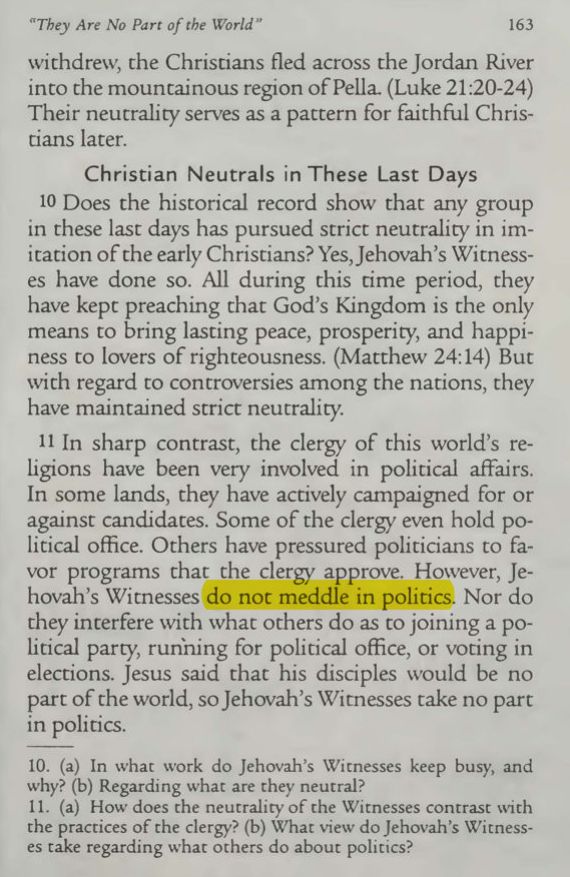
The religion teaches that a Christian's loyalty belongs to God's kingdom, not to any earthly government, and that believers should remain strictly neutral in the affairs of nations. In practice that means refusing military service, declining to vote or run for office, and not saluting national flags or singing anthems. The organization states the principle plainly in its own literature: "Jehovah's Witnesses do not meddle in politics."[4]
That stance is the historical reason the group has repeatedly been branded disloyal. But it was not, strictly, the legal basis for the 2017 ban — and the distinction is important to get right. The European Court noted that Russian law actually permits conscientious objectors to perform alternative civilian service in place of military duty, a right "consistently upheld by the Russian courts, including in cases where it was exercised by a Jehovah's Witness."[1] The ban did not rest on the refusal to serve.
It rested instead on the gap between two views of what religious freedom protects. Russian courts treated the Witnesses' insistence that they alone teach the truth, and their efforts to win converts, as the sowing of "religious discord." The European Court treats exactly those activities as protected: it has long held, since its landmark Kokkinakis judgment, that the freedom to "try to convince one's neighbour" is an essential part of religious liberty.[1] Where Russia saw extremism, Strasbourg saw evangelism — and ruled that punishing the latter as the former violated the Convention.
The human toll
The ban did not stay on paper. It reached into homes, interrogation rooms, and prison colonies.
The first Witness imprisoned under it was Dennis Christensen, a Danish carpenter who had lived for years in the city of Oryol. On May 25, 2017 — five weeks after the ruling — FSB officers interrupted a worship meeting at the Oryol Kingdom Hall, searched those present, searched Christensen's flat, and arrested him.[1] In February 2019 a district court sentenced him to six years in a general-regime penal colony for "continuing the activity of an extremist organisation"; the trial judge held that organizing the activity of a banned religious association "indicates in itself that the motive ... was religious hatred."[1] Christensen served five years before being released and deported to Denmark in May 2022.[5]
He was not the worst-treated. In February 2019, seven Witnesses detained in the Siberian oil city of Surgut alleged that investigators had tortured them — administering electric shocks, beating them, and attempting to suffocate them — when they refused to give information about fellow believers.[3] Russia's Investigative Committee first denied that any violence had occurred, then suggested the detainees had injured themselves, then attributed "insignificant injuries" to "active resistance"; no official was prosecuted, and Forum 18, a religious-freedom monitor, reported that some of the implicated investigators later received professional awards.[3] The case drew a rare foreign sanction: in September 2019 the United States imposed entry bans on two Surgut Investigative Committee officials and their families over the torture, a step the U.S. Commission on International Religious Freedom publicly welcomed.[5][12]
What the prosecutions had in common was their ordinariness. The conduct treated as "extremist activity" was, overwhelmingly, the substance of religious life — gathering to read the Bible, discussing the religion's literature, praying together in private homes. Investigators built cases by monitoring and recording worship meetings and then searching the homes of those who attended; the believers were prosecuted not for any harm done to another person but for the persistence of their worship.[1]
The scale climbed year over year. By the time the European Court ruled, it could record that, as of September 1, 2021, Russian authorities had charged 559 Witnesses under the extremism provisions, convicted 133, placed at least 255 in pre-trial detention or under house arrest, and searched more than 1,500 homes.[1] The numbers have only grown since. Tallies maintained by the Witnesses' own monitoring service and corroborated by the independent group Human Rights Without Frontiers put the cumulative total by the end of 2024 at 842 people prosecuted, 543 sentenced, and 186 imprisoned — with roughly 147 still behind bars.[7][8] These are self-reported and partisan figures in part, and should be read as such, but the order of magnitude is not seriously disputed.
Strasbourg's verdict — and its limits
On June 7, 2022, the European Court of Human Rights delivered its judgment in Taganrog LRO and Others v. Russia, a case joining twenty applications brought by Witness congregations and individuals.[1]
The Court found a cascade of violations of the European Convention: of Article 9 (freedom of religion) read with Article 11 (freedom of assembly) in the dissolution of the Administrative Centre and the local organizations; of Article 10 (freedom of expression) in the banning of the publications and the website; of Article 9 again in the criminal prosecution of believers for continuing to worship; of Article 5 in Christensen's detention; and of Article 1 of Protocol No. 1 in the confiscation of property.[1] It found the core violations by six votes to one. On the most pointed question — whether to order Russia to free the imprisoned believers and halt the prosecutions outright — the judges divided more closely, directing those individual measures by four votes to three.[1] Summarizing its own holding, the Court described a "policy of intolerance" by the Russian authorities toward the Witnesses.[1]
It ordered Russia to discontinue the pending criminal proceedings and release the imprisoned Witnesses, to return the seized properties within three months or pay for them, and to pay damages — 15,000 euros to each person criminally convicted, smaller sums to the others, and 125,000 euros in costs.[1]
There was a bitter precedent for what came next. Strasbourg had ruled for Russia's Witnesses once before: in 2010, in Jehovah's Witnesses of Moscow v. Russia, the same court found that Moscow's earlier dissolution of the local Witness community had violated the Convention's guarantees of religious freedom and assembly.[11] Russia banned the entire religion nationwide seven years later regardless. The 2022 judgment, in other words, was the second time the European Court had told Russia it was acting unlawfully toward Jehovah's Witnesses — and the second time the warning went unheeded.
By the time the judgment issued, much of it was already a dead letter. Russia had been expelled from the Council of Europe on March 16, 2022, weeks after its full-scale invasion of Ukraine, and it ceased to be a party to the European Convention on September 16, 2022.[6] Moscow has declared that it will not execute the Court's judgments. The property has not been returned; the prosecutions did not stop. The legal vindication the Witnesses won in Strasbourg has produced, inside Russia, no practical relief at all — only a steadily lengthening list of believers in penal colonies, 186 of whom had been imprisoned by the end of 2024.[7][8]
The long shadow
For Jehovah's Witnesses, persecution by a powerful state is not a novelty of the Putin era. It is something close to a recurring condition, and the 2017 ban sits in a line that stretches back through the bloodiest chapters of the twentieth century.
The same Soviet ground that produced the 2017 ban produced, seventy years earlier, the largest deportation of a religious group in the history of the USSR. In an operation code-named "North," carried out in early April 1951 under a plan approved by Stalin, Soviet authorities deported 9,793 Jehovah's Witnesses — men, women, the elderly, and children — from the western Soviet republics to special settlements in Siberia, some families given as little as two hours to gather their belongings before being loaded into freight cars.[9]
Further back still, under Nazi Germany, Jehovah's Witnesses were among the earliest religious targets of the regime — the first Christian denomination it banned outright — singled out for their refusal to swear loyalty oaths, give the Hitler salute, or serve in the military. Thousands were imprisoned, and many were sent to concentration camps, where they were identified by a distinctive purple triangle; hundreds were executed for refusing military service, and others died in custody.[10]
Historians and the Witnesses themselves draw the same throughline across these episodes: in each, a small, non-violent group's refusal of the state's loyalty rituals — the oath, the salute, the draft — was recast by the state as a threat to be eliminated. It is a pattern observed across very different regimes, not a single chain of cause and effect, and it is worth stating as such. But it is the frame within which Russia's own Witnesses now read their situation. The organization remains banned. The believers remain. And, as in 1951 and 1933, they have kept meeting.
Sources
- PrimaryEuropean Court of Human Rights, Taganrog LRO and Others v. Russia (Apps. 32401/10 and others), judgment of 7 June 2022 https://hudoc.echr.coe.int/eng?i=001-217535
- NewsHuman Rights Watch, "Russia: Court Bans Jehovah's Witnesses," 20 April 2017 https://www.hrw.org/news/2017/04/20/russia-court-bans-jehovahs-witnesses
- NewsForum 18, reporting on the Surgut torture allegations, 2019 https://www.forum18.org/archive.php?article_id=3036
- PrimaryWorship the Only True God (Watchtower, 2002), p.164 View scanned page →
- NewsThe Moscow Times, coverage of the Christensen case and U.S. sanctions, 2019–2022 https://www.themoscowtimes.com/2022/05/24/russia-releases-first-jehovahs-witness-imprisoned-for-extremism-a77786
- NewsCouncil of Europe, statement on Russia ceasing to be a party to the European Convention on Human Rights (16 September 2022) https://www.coe.int/en/web/portal/-/russia-ceases-to-be-a-party-to-the-european-convention-of-human-rights-on-16-september-2022
- NewsJehovah's Witnesses in Russia, prosecution statistics (2024) — a party source, cited for self-reported tallies https://jw-russia.org/en/news/2024/12/230900.html
- NewsHuman Rights Without Frontiers, 2024 statistics on the repression of Jehovah's Witnesses in Russia https://hrwf.eu/russia-statistics-about-the-harsh-repression-of-jehovahs-witnesses-in-2024/
- News"Operation North" (1951 Soviet deportation of Jehovah's Witnesses) — Communist Crimes / Memorial https://communistcrimes.org/en/ussrs-1951-deportation-jehovahs-witnesses
- PrimaryUnited States Holocaust Memorial Museum, "Jehovah's Witnesses" (Holocaust Encyclopedia) https://encyclopedia.ushmm.org/content/en/article/nazi-persecution-of-jehovahs-witnesses
- PrimaryEuropean Court of Human Rights, Jehovah's Witnesses of Moscow and Others v. Russia (App. 302/02), judgment of 10 June 2010 https://hudoc.echr.coe.int/eng?i=001-99221
- NewsU.S. Commission on International Religious Freedom, statement on the U.S. travel ban on Russian religious-freedom violators (2019) https://www.uscirf.gov/news-room/releases-statements/uscirf-statement-travel-ban-russian-religious-freedom-violators
Corrections: If you believe any factual statement here is inaccurate, please contact us. JW Files publishes corrections at the top of the original article and maintains a public corrections log.
Editorial note: This is a neutral news summary. Historical context, where present, is grounded in the Watchtower's own publications, shown as primary-source page images. Any interpretation lives in the separately-labeled editorial.