When Australia put the Jehovah's Witnesses' abuse record on the public record
In July 2015 an Australian Royal Commission opened public hearings into the Jehovah's Witnesses — and revealed that the organization's own files documented 1,006 alleged abusers since 1950, not one reported by the church to police.
On July 27, 2015, in a hearing room in Sydney, Australia's Royal Commission into Institutional Responses to Child Sexual Abuse opened a public examination of the Jehovah's Witnesses — and within its first day put on the record a figure the organization had never made public: its own files documented allegations against 1,006 alleged abusers since 1950, and not one of them had been reported by the church to the police.[1][2]
It was the first time the internal record of how the Witnesses handle child sexual abuse had been opened to public scrutiny by a body with the power to compel it.
What a Royal Commission is
A Royal Commission is the most powerful form of public inquiry in Australia — armed with the authority to summon witnesses, take sworn evidence under oath, and compel the production of documents that an institution would never volunteer. The national inquiry into child sexual abuse, which ran from 2013 to 2017, examined how dozens of institutions across the country — churches, schools, charities, government bodies — had responded to abuse in their care. Few emerged unscathed, and its findings carried the authority of the state rather than of any single lawsuit. Case Study 29 was its examination of the Jehovah's Witnesses and the Watchtower's Australian arm.[1]
For the Witnesses, who handle accusations of wrongdoing through their own internal judicial system and rarely air them outside the congregation, an inquiry with the power to demand the files was a singular event. It is what made July 27 a turning point: the organization's own internal records, opened to public view.
The records
The central revelation was documentary. The Commission had obtained the organization's Australian case files, and counsel assisting the inquiry, Angus Stewart, told the hearing that those records identified 1,006 alleged perpetrators since 1950, relating to more than 1,800 victims.[1][3]
The qualifier matters and must be stated precisely: not one of those cases had been reported by the organization to secular authorities.[1] That does not mean none ever reached the police — some did, by other routes — and the Commission itself referred matters involving hundreds of alleged perpetrators onward to the authorities.[3] What the records showed was an institution that had documented abuse in detail for decades and kept it within its own walls.
The two mechanisms
The inquiry trained its attention on two features of how the Witnesses handle abuse internally. The first is the two-witness rule: elders may not act on an accusation of serious wrongdoing without a second witness or a confession.[1]
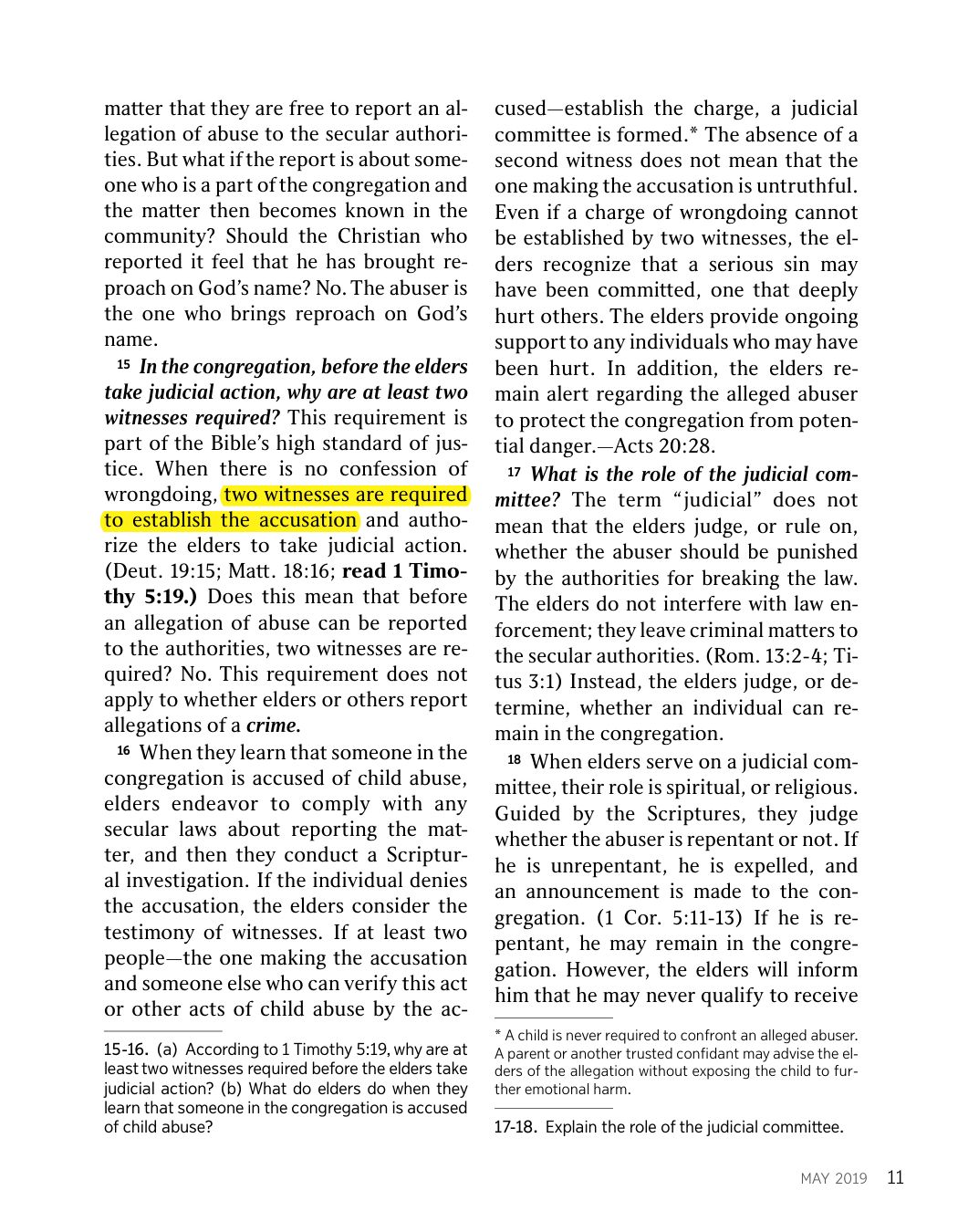
Counsel assisting put the problem plainly: because child sexual abuse is rarely committed in front of a second witness, the rule meant that in case after case, alleged perpetrators were never even questioned.[2]
The second feature is that these matters are weighed by judicial committees composed entirely of male elders. The Commission scrutinized both. An all-male committee meant that a woman or girl bringing an allegation would describe it to a panel of men — sometimes men she knew — with no woman among those deciding whether to believe her.[1] And the organization's practice of shunning those who leave the religion added a further pressure: a victim who lost faith in how the congregation handled her case, and chose to walk away, risked losing her family and community along with it. Going outside the congregation for help could itself be read as disloyalty.[1]
What the files showed
The records also revealed how the internal system resolved cases. Of the alleged perpetrators in the files, 401 had been expelled from the congregation through the organization's internal judicial process; more than half were later reinstated. Some 579 cases involved a confession.[3] These were matters handled, start to finish, inside an organization of roughly 70,000 members in Australia — and kept there.[2]
The hearings opened not with statistics but with people. The Commission heard evidence from survivors, whom it identified only by initials to protect their privacy, describing how their accounts had been handled by congregation elders. Counsel assisting, Angus Stewart, framed the organization's stance bluntly in his opening: by its own practice, he said, it did not report allegations of abuse to secular authorities, and the requirement of two witnesses before an internal committee could act meant that many alleged perpetrators were never even questioned.[2]
The human shape of those statistics came through in the survivors' accounts. One woman, identified only by initials, testified that she had been abused as a child by her own father, a member of the congregation. He was convicted and imprisoned — but only years later, and only after she herself went to the police, rather than relying on the elders who had first heard her account.[2] It was exactly the kind of case the Commission had convened to examine: an allegation that stayed inside the congregation until the survivor carried it out.
The road to the report
The hearings continued into August 2015 — including the sworn testimony of a member of the organization's worldwide Governing Body, examined in its own right.[1] When the Commission published its final report in October 2016, it went well beyond the two-witness rule. It recommended that the organization stop applying that rule in child-abuse cases, that it involve women in investigating allegations, and that it cease shunning members who leave the religion after being abused.[1] So long as the Witnesses relied on a literal interpretation of the Bible and first-century principles to set policy, the report concluded, the organization would "remain an organisation that does not respond adequately to child sexual abuse."[1]
But the foundation was laid on that first day in July, when the number 1,006 — drawn not from a critic or a survivor but from the Witnesses' own files — was read into the public record. For the first time, the scale of what the organization had documented internally, and kept there, became a matter of public knowledge.
The Watchtower has consistently maintained that it does not tolerate child abuse and that its procedures are grounded in scripture, and it has said it cooperated with the Commission's work. But the records the inquiry compelled told a story the organization had never volunteered — and could no longer keep to itself.
Sources
- NewsRoyal Commission into Institutional Responses to Child Sexual Abuse (Australia), Case Study 29: Jehovah's Witnesses (public hearings, July 2015; report October 2016) https://www.childabuseroyalcommission.gov.au/case-studies/case-study-29-jehovahs-witnesses
- NewsSydney Morning Herald (Rachel Browne), coverage of the opening of Case Study 29, 27 July 2015 https://www.bishop-accountability.org/news2015/07_08/2015_07_27_Rachel_Herald_Jehovah%27s_police.htm
- NewsNPR, BBC and CBC coverage of the 1,006 figure and the Case Study 29 records, July 2015 https://www.npr.org/sections/thetwo-way/2015/07/27/426756849/australias-jehovahs-witnesses-failed-to-report-1-006-alleged-child-sex-abuses
- PrimaryThe Watchtower (study edition), May 2019, p.11 View scanned page →
Corrections: If you believe any factual statement here is inaccurate, please contact us. JW Files publishes corrections at the top of the original article and maintains a public corrections log.
Editorial note: This is a neutral news summary. Historical context, where present, is grounded in the Watchtower's own publications, shown as primary-source page images. Any interpretation lives in the separately-labeled editorial.