Australia's Royal Commission and the Watchtower: what Case Study 29 found
In 2015 a national inquiry examined how the Jehovah's Witnesses organization in Australia responded to child sexual abuse. Its records showed 1,006 alleged perpetrators since 1950 — none reported by the organization to police.
Between July 27 and August 14, 2015, in a hearing room in Sydney, the Australian Royal Commission into Institutional Responses to Child Sexual Abuse turned its attention to the Jehovah's Witnesses. The hearing — designated Case Study 29 — examined how the organization and the Watchtower Bible and Tract Society of Australia had handled allegations of child sexual abuse within their congregations over more than half a century.[1]
What the inquiry found came, in large part, not from outside critics but from the organization's own records — and from the testimony of its own representatives, including, for the first time in such a proceeding, a member of its highest governing council.
The number that defined the hearing
The figure that anchored Case Study 29 belonged to the organization itself. Counsel assisting the Commission established that, since 1950, the Jehovah's Witnesses' Australian records documented allegations of child sexual abuse against 1,006 of its members. Not one of those alleged perpetrators, the Commission heard, had been reported by the organization to police or any other secular authority.[1][2]
Those allegations had been handled instead within the organization's own disciplinary system. Of the 1,006, the Commission heard, 401 had been "disfellowshipped" — formally expelled and shunned — over the allegations. More than half of those expelled were later reinstated to full membership.[1][2]
A justice system of its own
To make sense of those numbers, the Commission had to map a structure most Australians had never seen. Jehovah's Witnesses handle accusations of serious wrongdoing — including crimes — internally, through congregation elders: unpaid lay men, not clergy in the usual sense, who lead each congregation and convene "judicial committees" to investigate and rule on allegations. The possible outcomes are religious, not legal: counsel, formal reproof, or disfellowshipping.
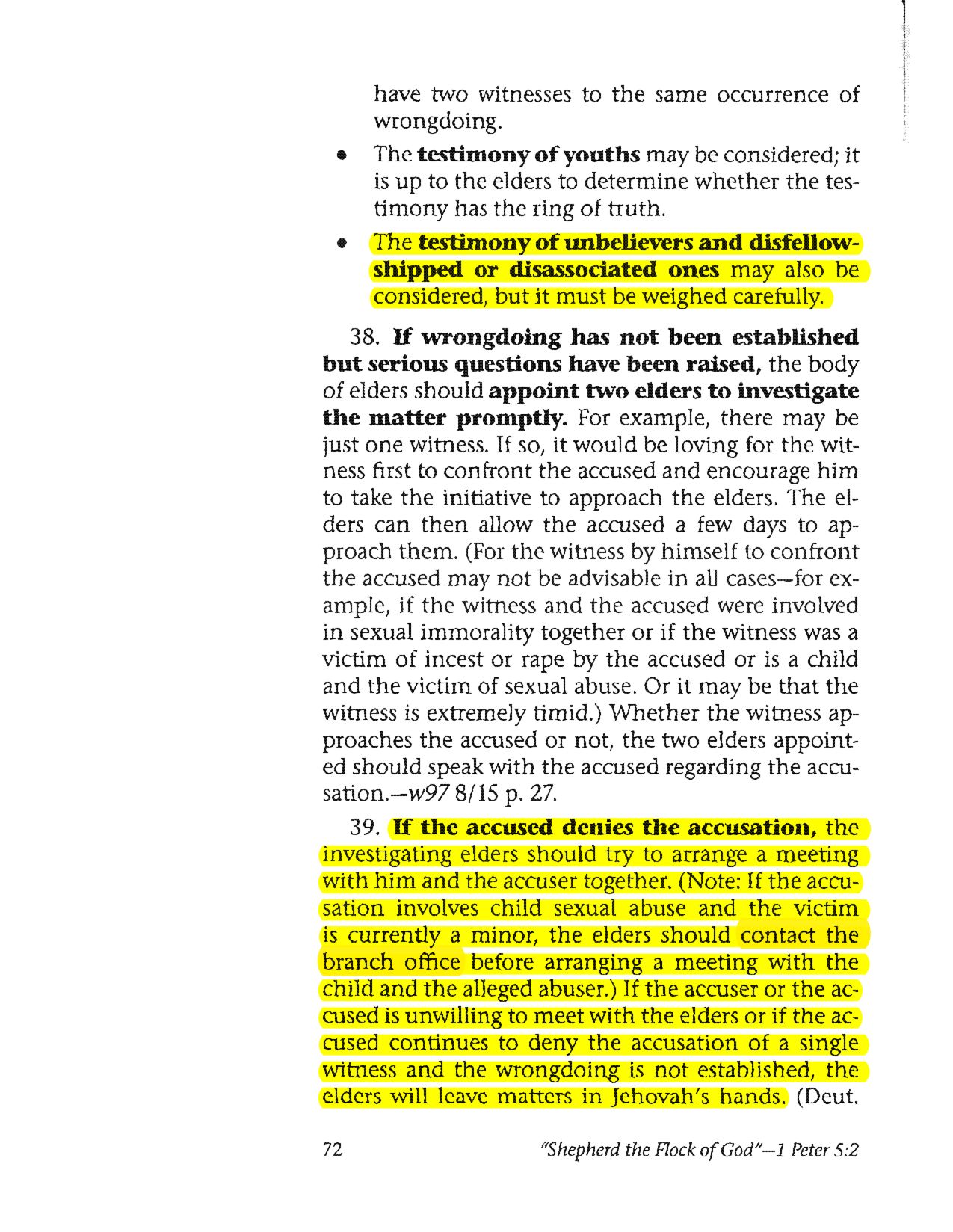
The system was also channeled upward. The organization's elders' manual instructed that when an allegation involved the sexual abuse of a child, elders were to telephone the organization's branch office — its legal and administrative headquarters — before acting. As the 2010 edition of the manual, Shepherd the Flock of God, put it, where a minor was involved "the elders should contact the branch office before arranging a meeting with the child and the alleged abuser."[3]
The effect was that how to respond to an accusation of child sexual abuse was decided inside a religious process, guided by the organization's own legal department, rather than referred out to police or child-protection authorities.
The two-witness rule
At the center of the inquiry sat an evidentiary standard the organization draws from its reading of scripture: the requirement of two witnesses before its elders will take judicial action on an accusation. The rule rests on biblical passages — the instruction in Deuteronomy that a matter must be established "on the testimony of two witnesses," echoed in the Gospel of Matthew and in Paul's first letter to Timothy.
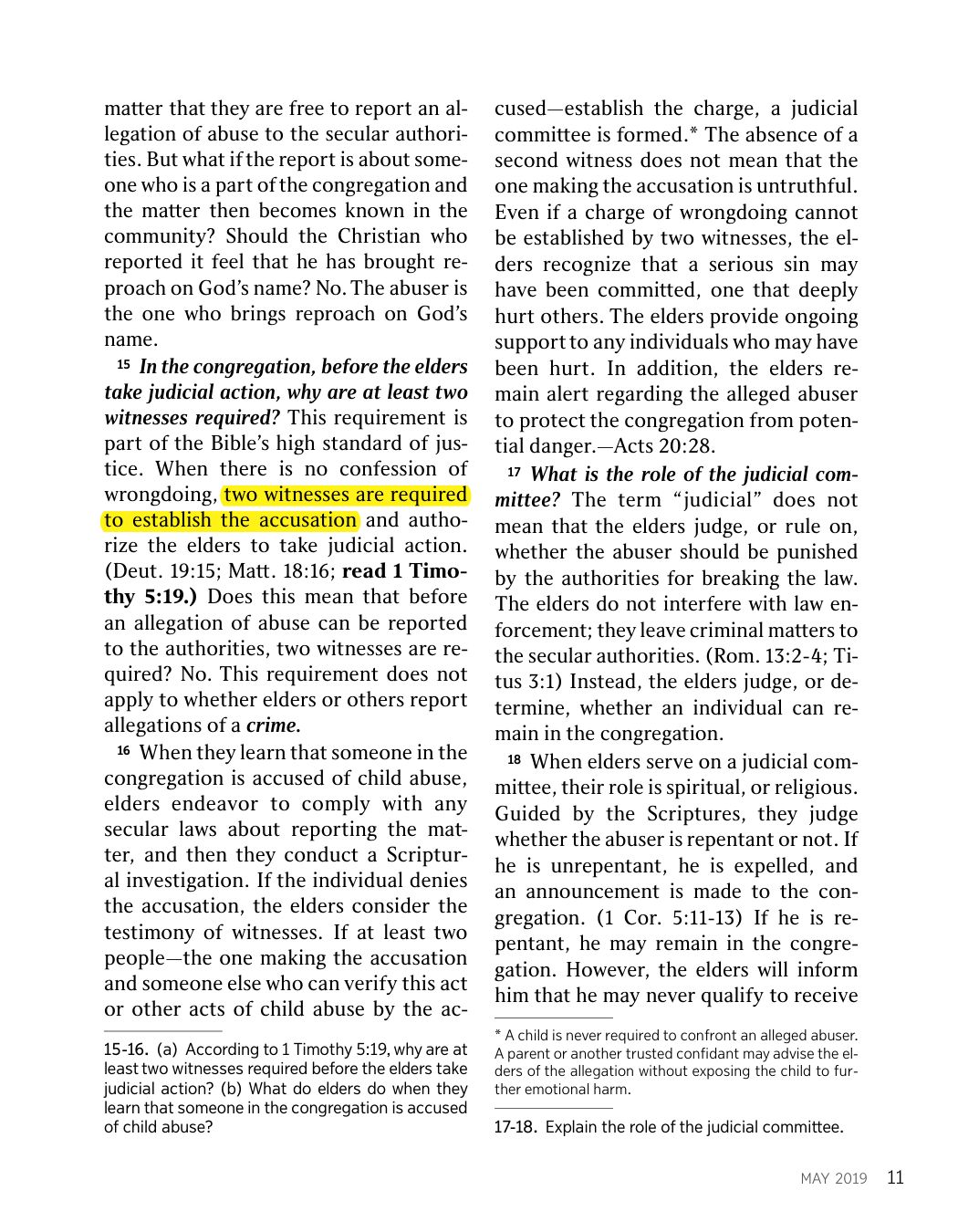
The rule long predates the inquiry, and the organization has described it plainly in its own pages. "When there is no confession of wrongdoing," a May 2019 study article in The Watchtower states, "two witnesses are required to establish the accusation and authorize the elders to take judicial action."[4]
Applied to child sexual abuse, the standard has an obvious problem, which the Commission set out directly: such abuse almost never happens in front of a second witness. Where a child's account stood alone and the accused denied it, the matter could not be established, and the internal process went no further. The Commission's final report concluded that the organization's "retention and continued application of policies such as the two-witness rule in cases of child sexual abuse shows a serious lack of understanding of the nature of child sexual abuse," and recommended the organization abandon it in abuse cases.[5]
A process built around men
The Commission also scrutinized who sat in judgment. Judicial committees are composed of male elders; women do not serve on them and cannot. For a female complainant, that meant bringing an account of abuse before a panel of men.
The Commission's chair, Justice Peter McClellan, drew out the consequence. A woman or girl, he observed, "would have to confront ultimately three men in the presence of the abuser and without moral support."[6] The Commission recommended that women be involved in investigating and determining abuse allegations — a change the organization's theology, which reserves such authority to men, does not readily accommodate.
The Governing Body in the witness box
The hearing produced an extraordinary moment. The Jehovah's Witnesses are led by a small body in the United States known as the Governing Body, which sets doctrine and policy for the religion worldwide and which the organization presents to members as God's channel of communication. The Commission sought evidence from a Governing Body member; the organization resisted. The matter resolved when one of them, Geoffrey Jackson, was found to be in Australia visiting his ailing father, and was subpoenaed.
Jackson testified on August 14, 2015. Counsel assisting the Commission later submitted that he had been "evasive and unhelpful" in helping the Commission understand whether the two-witness rule could be read to allow action where there was only one direct witness to abuse.[7] His appearance was historic regardless: a member of the organization's highest authority, answering questions under oath about how the faith handles the abuse of children.
The findings
The Commission's report on Case Study 29, dated October 2016, was direct. It concluded that children "are not adequately protected from the risk of child sexual abuse" within the Jehovah's Witnesses organization, and that the organization "does not respond adequately" to allegations, relying on policies that were not subject to ongoing review.[5]
Why it still matters
Case Study 29 did not close the subject; it opened it. The Australian findings became a reference point for scrutiny of the organization elsewhere — in the Netherlands, where a government-commissioned study reached similar conclusions, and in the United States, where a Pennsylvania grand jury would later examine the same internal-reporting practices. In Australia itself, the organization at first declined to join the national redress scheme for institutional abuse survivors, agreeing only in 2021 after legislation compelled participating charities. The 1,006 figure — the organization's own count, never reported — remains among the most cited in the global record of how the Watchtower has handled child sexual abuse.
Sources
- NewsRoyal Commission into Institutional Responses to Child Sexual Abuse, "Case Study 29: Jehovah's Witnesses" https://www.childabuseroyalcommission.gov.au/case-studies/case-study-29-jehovahs-witnesses
- NewsRachel Browne, The Sydney Morning Herald, July 27 2015 (corroborated by BBC and NPR) https://www.bbc.com/news/world-australia-33673240
- PrimaryShepherd the Flock of God (2010 elders' manual), p.75 View scanned page →
- PrimaryThe Watchtower (study edition), May 2019, p.11 View scanned page →
- NewsRoyal Commission, Report of Case Study No. 29 (Findings), October 2016 https://www.childabuseroyalcommission.gov.au/media-releases/report-jehovahs-witness-organisations-released
- NewsJustice Peter McClellan, quoted in The Conversation, 2015 https://theconversation.com/jehovahs-witness-hierarchy-means-child-sex-abuse-goes-unreported-45651
- NewsCounsel Assisting, submissions concerning Geoffrey Jackson, Royal Commission, 2015 https://www.childabuseroyalcommission.gov.au/case-studies/case-study-29-jehovahs-witnesses
Corrections: If you believe any factual statement here is inaccurate, please contact us. JW Files publishes corrections at the top of the original article and maintains a public corrections log.
Editorial note: This is a neutral news summary. Historical context, where present, is grounded in the Watchtower's own publications, shown as primary-source page images. Any interpretation lives in the separately-labeled editorial.