Norway's Supreme Court ended a years-long fight over Jehovah's Witnesses' funding and shunning
In April 2026 Norway's highest court ruled the state acted unlawfully when it deregistered Jehovah's Witnesses and cut their funding over shunning. The justices were unanimous that the state had not shown harm to children — and split only on a separate question about adults. It was the end of a five-year fight, and part of a wider European reckoning.
On April 29, 2026, the Supreme Court of Norway ended a fight that had run through the country's courts for five years, ruling that the Norwegian state acted unlawfully when it stripped Jehovah's Witnesses of their registration as a religious community and cut off their state funding over the way the group treats members who leave.[1] The decision invalidated a stack of government actions — five separate refusals of the annual state subsidy, the 2022 deregistration, and a rejected application to re-register — and it is final. The case, numbered HR-2026-1009-A, cannot be appealed.[1][2]
It was reported in many places as a "3-2" decision, and that shorthand is worth correcting at the outset, because it misrepresents what the court actually held. On the question that had animated the whole dispute — whether Jehovah's Witnesses harm the children in their congregations — the five justices were effectively unanimous: the state, they found, had not produced sufficient evidence that the religion subjects minors to psychological violence or unlawful social control.[1] The court split only on a separate, narrower question about adults. The outcome was not close: the government's decisions were invalid.
The ruling is a landmark for religious-freedom law in Europe, and to understand why, an outsider needs three things — how Norway pays for religion, what practice the state was objecting to, and how the case climbed from a single ex-member's complaint to the country's highest court.
How Norway funds religion
Norway does something most countries do not: it directly funds faith. The arrangement reflects the country's particular church-state history — the state long maintained an established Evangelical Lutheran church, and in the name of even-handedness it extends comparable support to other faiths. Under the Religious Communities Act — the Trossamfunnsloven, which took effect on January 1, 2021 — the state pays a per-member grant to every registered religious or life-stance community, with the amount pegged to what the government spends per member on that majority church.[7] Hundreds of communities draw on the system, from large Muslim and Catholic congregations to humanist associations.
Registration is the gateway to that money, and the 2021 law lowered the bar to enter — from a 500-member minimum to just 50.[7] The per-member grant is modest on its own — a little over a thousand kroner a year — but across a congregation it adds up, and more than 700 registered communities draw on it.[5][7] The same law, however, added explicit grounds for refusing a grant, including conditions tied to discrimination, gender equality, and a community's treatment of children. Those provisions are the statutory hook the state would later use against the Witnesses.
Losing registration costs a community more than cash. A registered, licensed community in Norway may also solemnize legally recognized marriages; deregistration strips that authority away.[7] For the roughly 12,000 Jehovah's Witnesses in Norway, then, the state's action threatened not only an annual subsidy reported at around 16 million kroner but the community's standing to conduct weddings the state would recognize.[5] (Figures for the subsidy and membership come largely from press accounts and should be read as approximate.)
The practice at issue
What the Norwegian state objected to was shunning.
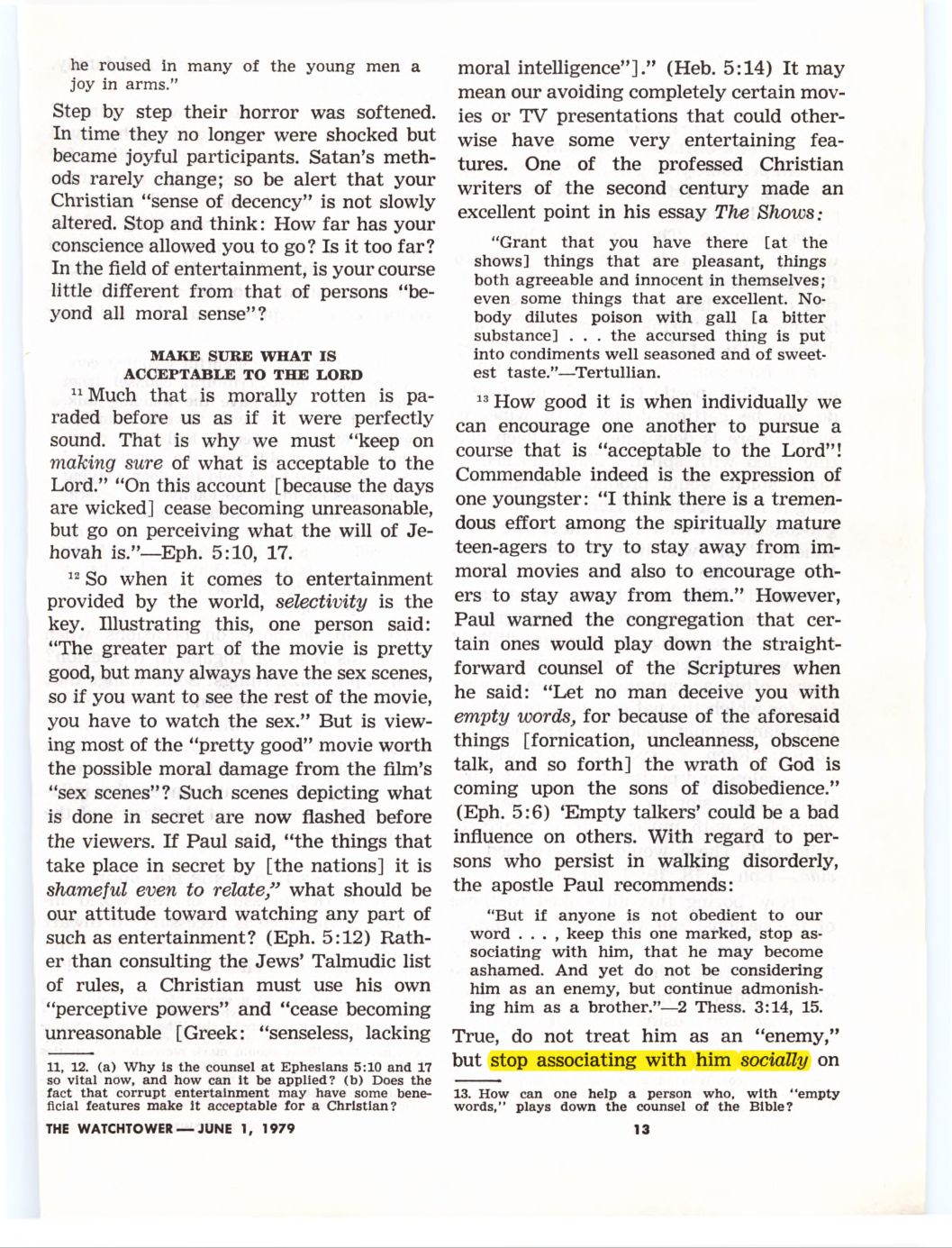
When a Jehovah's Witness is expelled, or formally leaves, the congregation is told, and other members — and, with limited exceptions for immediate family — are directed to cut off social contact with that person. In practice that means no socializing, no shared meals, and, for relatives outside the household, contact kept to necessary matters. The organization has described the practice in its own publications for decades. A 1979 issue of The Watchtower instructs that a disfellowshipped person is not to be treated as an "enemy," "but stop associating with him socially."[4]
The Norwegian authorities framed that practice in the vocabulary of harm. In denying the subsidy and then deregistering the group, the County Governor's office argued that shunning amounted to coercion and "negative social control" — that it pressured members who might otherwise leave, and that it fell hardest on children, including baptized minors who could themselves be subject to being shunned. "We consider social isolation as a form of punishment against the child," the state's office said in setting out its rationale.[5]
The Witnesses cast the same practice in the language of religious freedom: a voluntary expression of a scripturally grounded community's right to define its own membership and conduct, protected by the autonomy that religious bodies enjoy under Norwegian law and the European Convention on Human Rights. The Supreme Court would ultimately have to weigh those two framings — protection of the vulnerable against the self-governance of a faith — and decide where Norwegian law drew the line.
A five-year arc
The case began, as such cases often do, with one person. In 2021, a former member named Rolf Furuli complained to the Norwegian government that the Witnesses' shunning practice blocked members — including minors — from freely leaving the religion.[3]
The state responded in stages. On January 27, 2022, the County Governor for Oslo and Viken denied the Witnesses their state subsidy, citing the shunning practice; the national Ministry confirmed the denial that autumn.[3] Then, on December 22, 2022, the County Governor went further and deregistered the organization altogether — it had been a registered community since 1985 — and refused its application to re-register.[3]
The Witnesses sued, and the case see-sawed through the courts. In 2024 the Oslo District Court sided with the state, accepting that the shunning practice gave the government lawful grounds to withhold funding and registration. In March 2025 the Borgarting Court of Appeal reversed, unanimously, restoring the group's standing and awarding it roughly 8.5 million kroner in costs.[3][11] The state took the case to the Supreme Court, which heard it in 2026 — and, on April 29, brought the five-year arc to a close in the Witnesses' favor.[1] Win, lose, win, win: four courts had now weighed the same practice, and the highest of them had the last word.
The test the court set
The Supreme Court's reasoning, set out in its official summary, rested on a high bar for state interference with religion.
"The threshold for refusing state funding and registration is high," the court held, and the relevant provision of the funding law "must be interpreted in the light of the autonomy of religious communities."[1] On the central question of children, it found the evidence wanting: the state, it wrote, "had not provided sufficient evidence that ... Jehovah's Witnesses subject minor members to psychological violence or negative social control."[1] That conclusion commanded the whole court.
The split, when it came, was over adults. A majority concluded that the shunning practice "does not constitute undue pressure on members in breach of Article 9 of the European Convention on Human Rights" — the guarantee of freedom of religion.[1] The majority drew a fine but consequential distinction. Shunning, it acknowledged, exerts an "indirect pressure" on a member weighing whether to leave; but members "are not subjected to direct pressure, such as threats of sanctions," and — the court reasoned — an indirect state requirement that the Witnesses keep up contact with former members, on pain of losing their funding, would itself amount to pressure on individual believers.[5][3] Two of the five justices disagreed, but only on that single question of whether shunning unlawfully pressures adult members who might wish to leave. On the disposition, the result was decisive: the state's decisions were set aside as invalid.
In reaching that result the court drew on a principle the European Court of Human Rights had articulated years earlier. In its 2010 judgment in Jehovah's Witnesses of Moscow v. Russia, Strasbourg held that "the autonomous existence of religious communities is indispensable for pluralism in a democratic society," and that the state's duty of neutrality "is incompatible with any power on the State's part to assess the legitimacy of religious beliefs."[6] Norway's high court placed its own ruling in that tradition: the state could regulate harm, but it could not penalize a religious community simply because its internal rules differed from the majority's.
A representative of the Witnesses welcomed the decision. "The decision protects several fundamental human rights for all people in Norway, including freedom of religion and personal autonomy," said Jørgen Pedersen of the religion's Scandinavia branch committee, adding that the Witnesses "endeavor to treat former associates in a loving, kind, and dignified manner."[2] Massimo Introvigne, a scholar of new religious movements who tracked the litigation, called the judgment important because, in his reading, "it reinstates the principle that the State cannot penalize a religious community simply because its internal rules differ from those of the majority."[3]
The European frame
Norway's case did not arise in isolation. It is one front in a continent-wide argument over whether, and how, the state may respond to religious shunning — and the answers have varied sharply by country.
Belgium offered the closest parallel, and it ran the opposite way before arriving at a similar place. In March 2021, a court in Ghent convicted the Belgian Jehovah's Witness association of discrimination and incitement to hatred over its shunning instruction, imposing a fine of around 96,000 euros. But in June 2022 the Ghent Court of Appeal overturned the conviction, treating the practice as protected expression and association, and in December 2023 Belgium's Court of Cassation affirmed the acquittal — holding that Articles 8 and 9 of the Convention "imply that everyone has the right to decide independently with whom to maintain social contacts and with whom not."[8] As in Norway, the courts ultimately landed on the side of the religion's autonomy.
Other European pressure has taken different forms. In the United Kingdom, the Charity Commission opened a statutory inquiry into the Witnesses' British arm in 2014 over safeguarding — a regulatory rather than a shunning case, but part of the same broad scrutiny.[9] And at the far, repressive end of the spectrum sits Russia, whose Supreme Court banned the Jehovah's Witnesses outright as "extremist" in 2017, liquidating hundreds of local organizations — in open defiance of the very Strasbourg autonomy doctrine that Norway's court would later invoke.[10]
Set against that range — from Russia's prohibition to Norway's protection — the Norwegian Supreme Court's judgment marks one pole of a European consensus still being negotiated: that a democratic state may guard its citizens, and especially its children, from genuine harm, but that the bar for punishing a faith over its own rules of membership is, in the court's word, "high."[1]
Sources
- PrimarySupreme Court of Norway, judgment HR-2026-1009-A (official summary), 29 April 2026 https://www.domstol.no/en/supremecourt/rulings/rulings-2026/supreme-court---civil-cases/HR-2026-1009-A/
- NewsJehovah's Witnesses, statement on the Norwegian Supreme Court ruling (jw.org) — a party source https://www.jw.org/en/news/region/norway/Norwegian-Supreme-Court-Issues-Significant-Ruling-in-Favor-of-Jehovahs-Witnesses/
- NewsMassimo Introvigne / Bitter Winter, reporting on the Norwegian case (2022–2026) https://bitterwinter.org/jehovahs-witnesses-win-landmark-case-at-the-norwegian-supreme-court/
- PrimaryThe Watchtower, June 1, 1979, p.333 View scanned page →
- NewsThe Friendly Atheist (Hemant Mehta), coverage of the Norway case and its financial figures — cited for the state's rationale and reported NOK figures https://www.friendlyatheist.com/p/norways-highest-court-upholds-state
- PrimaryEuropean Court of Human Rights, Jehovah's Witnesses of Moscow and Others v. Russia (App. 302/02), 10 June 2010 https://hudoc.echr.coe.int/eng?i=001-99221
- PrimaryNorwegian Ministry of Children and Families, guidance on the Religious Communities Act (Trossamfunnsloven, 2021) https://www.regjeringen.no/en/documents/norwegian-guidelines-for-freedom-of-religion-or-belief/id2983169/
- NewsBitter Winter / Human Rights Without Frontiers, reporting on the Belgium (Ghent) shunning case, 2021–2023 https://bitterwinter.org/the-ghent-saga-ends-belgium-cassation-court-confirms-that-shunning-is-lawful/
- PrimaryUK Charity Commission, statutory inquiry into the Watch Tower Bible and Tract Society of Britain (opened 2014) https://www.gov.uk/government/publications/charity-inquiry-watch-tower-bible-and-tract-society-of-britain/charity-inquiry-watch-tower-bible-and-tract-society-of-britain
- NewsHuman Rights Watch, "Russia: Court Bans Jehovah's Witnesses," 20 April 2017 https://www.hrw.org/news/2017/04/20/russia-court-bans-jehovahs-witnesses
- NewsJehovah's Witnesses, statement on the Borgarting Court of Appeal ruling (jw.org), March 2025 — a party source https://www.jw.org/en/news/region/norway/Court-of-Appeal-Unanimously-Overturns-Unconstitutional-Ruling-in-Norway/
Corrections: If you believe any factual statement here is inaccurate, please contact us. JW Files publishes corrections at the top of the original article and maintains a public corrections log.
Editorial note: This is a neutral news summary. Historical context, where present, is grounded in the Watchtower's own publications, shown as primary-source page images. Any interpretation lives in the separately-labeled editorial.