A Montana jury ordered the Watchtower to pay $35 million for not reporting abuse. The state's top court erased it.
A 2018 Montana jury ordered the Watchtower to pay about $35 million for failing to report a child's abuse. In 2020 the state's Supreme Court erased the verdict — unanimously — not on the facts, but on a clergy-confidentiality exception in the reporting law. The collision it turned on is still unresolved across the country.
In September 2018, a jury in Sanders County, Montana, returned one of the largest verdicts ever entered against the Jehovah's Witnesses organization in a child-abuse case: roughly $35 million, awarded to Alexis Nunez, a former member who said the congregation she grew up in had known she was being sexually abused and never told the authorities.[1][3] Sixteen months later, the Montana Supreme Court erased it — unanimously, seven justices to none.[1][2]
What the court did, and what it pointedly declined to do, are easy to confuse and worth separating with care. The justices did not find that the abuse had not happened. They did not rule that the organization had behaved well, or that its officials had exercised sound judgment. They held something narrower and, in its way, more consequential: that under the specific wording of Montana's child-abuse reporting law, the congregation's elders were not legally required to report what they had been told, because their religion treated such reports as confidential. The verdict fell not on the facts of the abuse but on a clergy-confidentiality exception buried in a reporting statute.[1]
This is the story of that case — and of the much larger, unresolved collision it sits inside: between laws written to pull child abuse into the light and religious bodies that have long insisted on handling it in the dark.
What happened in Thompson Falls
The events at the center of the case unfolded in a small congregation in Thompson Falls, in Montana's rural northwest. Nunez was abused as a child within the Witness community. In 2004, the abuse was reported to congregation elders.[1]
What the elders did next is the legal heart of the case. According to the Montana Supreme Court's opinion, they did not call the police. They called the Watchtower's legal department, and an attorney there advised them that Montana law did not require them to report the abuse to secular authorities.[1] A congregation judicial committee — a panel of elders convened to weigh accusations of serious wrongdoing — addressed the matter internally; the man was expelled and then, about a year later, reinstated into the congregation.[1]
Years later, Nunez sued the Watchtower Bible and Tract Society of New York and an affiliated corporation, the Christian Congregation of Jehovah's Witnesses, on a theory of negligence: that the organization was a "mandatory reporter" under Montana law — one of the professionals legally obligated to report suspected child abuse — and that its failure to report was negligence as a matter of law. The trial judge in Sanders County agreed on the central legal question, ruling before trial that the Witnesses were mandatory reporters and had a duty to report, leaving the jury to decide only what the failure had cost.[1] In September 2018 the jury answered with about $4 million in compensatory damages and $31 million in punitive damages — the punitive award split $30 million against the New York Watchtower corporation and $1 million against the Christian Congregation.[1][3]
The reversal, precisely
On January 8, 2020, the Montana Supreme Court reversed and ordered judgment entered for the organizations. The decision was unanimous.[1][2]
The court's reasoning turned entirely on the text of Montana's reporting statute, §41-3-201. Clergy are indeed listed among the professionals required to report suspected child abuse. But the same statute contains an exception, and the exception decided the case. Subsection (6)(c) provides that "a member of the clergy or a priest is not required to make a report ... if the communication is required to be confidential by canon law, church doctrine, or established church practice."[1]
The question, then, was not whether the elders had clergy status — they did, for the statute's purposes — but whether the Witnesses' own doctrine and practice required that reports of abuse be kept confidential. Reviewing the record, the court concluded that they did: "the undisputed material facts demonstrate the Jehovah's Witnesses maintain confidentiality pursuant to church doctrine, canon, and/or established practice when they receive and internally address reports of child sexual abuse."[1] On that finding, the clergy exception applied, and the duty the trial court had imposed dissolved.
Two features of the ruling are essential to reading it accurately. First, it was bound to the evidentiary record. The plaintiff, the court noted, had not produced evidence to rebut the organization's testimony that it handles such reports confidentially; the case had been decided on summary judgment, and the court confined itself to "the summary judgment record."[1] A different record — different testimony, different evidence about how the religion actually treats these reports — might have produced a different result.
Second, the court went out of its way to disclaim any larger judgment about whether the law was wise or the conduct defensible. "This Court's task," it wrote, "is to interpret what is contained in the reporting statute as written by the Legislature. We do not opine whether that body could have made a different policy choice that would afford greater protection to child victims. The Legislature is the appropriate body to entertain such policy arguments."[1] And it declined to sit in judgment of the religion's internal process, saying it was "mindful not to scrutinize the process they followed" for compliance with their own doctrine.[1] The reversal was a reading of one statute — not an absolution.
The policies underneath
To understand what the elders were doing when they telephoned the legal department instead of the police, an outsider needs to know about two features of how Jehovah's Witnesses handle accusations internally.
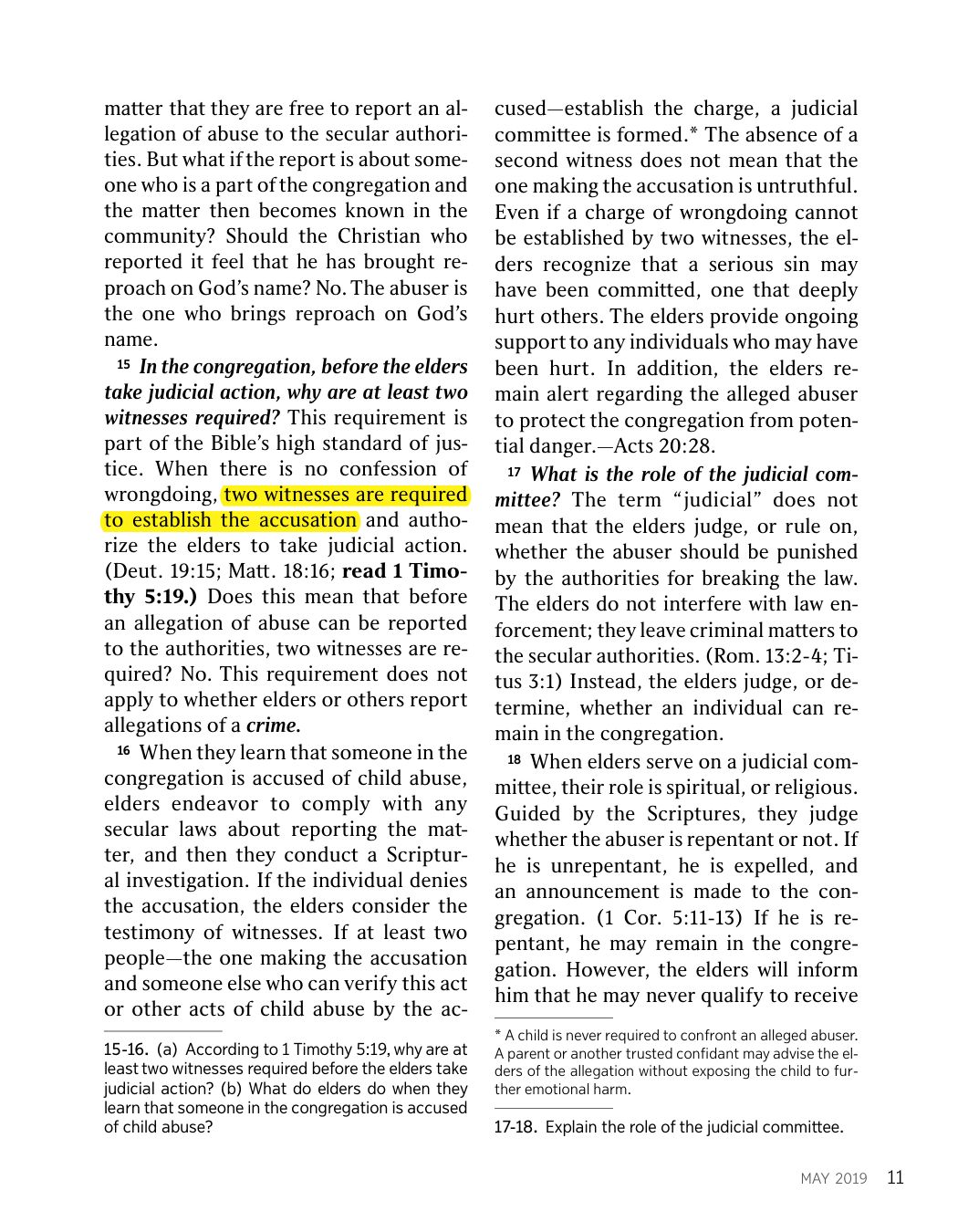
The first is the two-witness rule. Drawn from a reading of scripture — the requirement at Deuteronomy 19:15 and elsewhere that a matter be established by two or three witnesses — it holds that elders cannot take internal disciplinary action on an accusation of serious wrongdoing unless there is either a confession or a second witness. The organization states the rule plainly in its own publications: "When there is no confession of wrongdoing, two witnesses are required to establish the accusation and authorize the elders to take judicial action."[4]
The rule governs internal religious discipline, and the organization maintains that it does not bar anyone from reporting a crime to the police. But critics — and several national inquiries — have argued that because child sexual abuse is almost never committed in front of a second witness, the rule structurally prevents the organization from acting on most allegations. As the United Kingdom's Independent Inquiry into Child Sexual Abuse put it, "by its very nature child sexual abuse is most often perpetrated in the absence of witnesses."[11]
The second feature is the instruction that elders telephone the organization before responding to an abuse report. The confidential elders' manual, Shepherd the Flock of God, directs that when an accusation involves a child, the elders "should contact the branch office" before proceeding.[5]
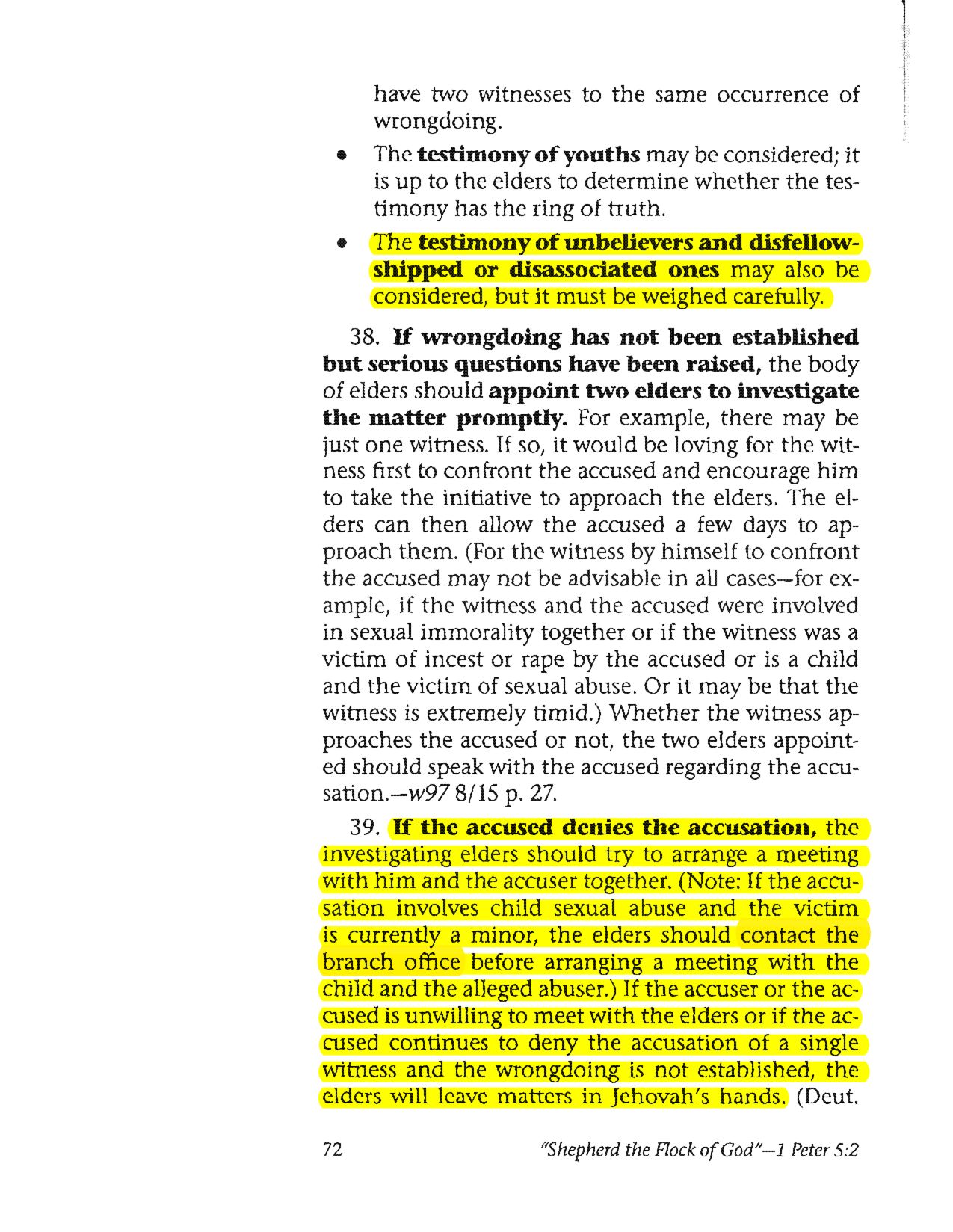
That directive — call the organization's legal department first — is exactly what the Thompson Falls elders did. And it is the practice the Montana Supreme Court ultimately treated as the "established church practice" of confidentiality that triggered the statutory exception.
What the elders were told when they made such a call has itself been questioned. Australia's Royal Commission, examining the same branch-contact practice, found that the organization's legal department had "routinely provided incorrect information to elders" about their obligations under that country's mandatory-reporting laws.[7] In Montana, the advice the elders received — that the law did not require them to report — became, by the Supreme Court's reading, not a failure but a protected exercise of the religion's own confidentiality.
A wider pattern
The Montana case was not an isolated event. It was one episode in a long, multi-country reckoning over how the Witnesses handle child sexual abuse — and the reversal looks different against that backdrop.
The most direct American precursor was Conti v. Watchtower, in California. In 2012 an Alameda County jury awarded a former member, Candace Conti, a headline figure of roughly $28 million — about $7 million in compensatory damages and some $21 million in punitive damages — after finding that the organization bore responsibility for her abuse by a fellow congregant the leadership knew had previously molested a child.[6] But the final outcome was far smaller and is often misreported. The trial court cut the punitive award; then, in 2015, a California appeals court went further — it upheld the finding that the organization had negligently failed to supervise a known molester, but eliminated the punitive damages entirely and rejected the theory that leaders had a duty to warn the congregation. The court reasoned that while "it is readily foreseeable that someone who has molested a child may do so again," the burdens and "adverse social consequences" of imposing a duty to warn outweighed it.[6] The jury had originally apportioned fault three ways — 60 percent to the abuser, 27 percent to the Watchtower, and 13 percent to the local congregation — but after the appeal, the case settled for a fraction of the headline figure.[6] The lesson litigators drew was sobering: even where a jury found the organization negligent, the law gave it ample room to escape the largest consequences.
Behind both cases lies an internal document. A March 14, 1997 letter to elders in the United States directed them to report known child molesters within the congregation up the chain, to the branch office — instructions that, over time, seeded a centralized internal record of abuse allegations. The existence of such a database was reported by the BBC's Panorama as early as 2002.[10] To critics, it captured the core contradiction: the organization had, for years, been gathering precisely the information that reporting laws were written to route to the authorities — and keeping it inside.[10]
The most sweeping external examination came not in the United States but in Australia. In 2015 and 2016, the Royal Commission into Institutional Responses to Child Sexual Abuse devoted a case study to the Jehovah's Witnesses and obtained the organization's own records. Those records documented allegations against 1,006 alleged perpetrators since 1950, relating to more than 1,800 victims — and, the Commission found, not one of them had been reported by the organization to the police.[7] That figure is widely cited, and it needs its qualifier to be fair: it means none were reported by the organization. Some cases reached the authorities by other routes, and the Commission itself referred 514 of the alleged perpetrators to police.[7] The Commission's verdict on the two-witness rule was blunt: retaining it in child-abuse cases, it wrote, "shows a serious lack of understanding of the nature of child sexual abuse."[7]
The pattern has continued to surface across the English-speaking world and beyond. The United Kingdom's Charity Commission opened a statutory inquiry into the Witnesses' British arm in 2014 over safeguarding, and the country's Independent Inquiry into Child Sexual Abuse returned to the two-witness rule in 2022 with a scathing assessment: its "continuing use," the inquiry wrote, "shows a disregard of the seriousness of the crimes involved and their impact on individuals. It also lacks compassion for the victim, and serves to protect the perpetrator."[11] A Dutch study in 2020 documented 751 abuse reports within the Netherlands' Witness community and likewise found the organization did not report them to the police; the Dutch government later opened a dedicated hotline.[13] In Pennsylvania, a grand-jury investigation that began in 2019 subpoenaed Witness congregations across the state for decades of abuse records, and by 2023 nine men affiliated with the religion had been charged.[12]
The fault line
Step back from any single case and a larger, unresolved tension comes into view — the one the Montana ruling turned on. It is the conflict between two principles a democratic society holds simultaneously: that clergy should be able to receive confidences without becoming agents of the state, and that children must be protected from abuse that thrives on secrecy.
The clergy-penitent privilege is old and widely held, and Montana's exception is far from unique. An Associated Press investigation in 2022 found that in 33 states, clergy are exempt from laws requiring professionals such as teachers and physicians to report child sexual abuse, where the information is deemed privileged.[8] The AP counted more than 130 bills introduced across the states over two decades to create, expand, or defend such exemptions; it reported that the Catholic Church's well-funded lobbying often led the effort, and that influential members of other faiths — including the Mormon church and the Jehovah's Witnesses — had also worked in statehouses and courts to preserve the privilege where their membership was concentrated.[8]
That settlement is now being contested. In May 2025, Washington State enacted a law making clergy mandatory reporters of child abuse with no exception for information learned in a religious confession — a change its sponsors tied directly to investigative reporting on the Jehovah's Witnesses. The U.S. Department of Justice opened an inquiry into whether the law violated the First Amendment's protection of religious exercise.[9] Australia, after its Royal Commission, moved in the opposite direction from Montana, with several states criminalizing the failure to report abuse even when the information came through religious confession.[8]
The Montana Supreme Court, confronting that fault line, chose the modest path it said was its only one: it read the statute the legislature had written and left the policy question to the legislature. "We do not opine," the justices wrote, "whether that body could have made a different policy choice that would afford greater protection to child victims."[1] The $35 million verdict is gone. The question it raised — who must speak, and who may keep silent, when a child is harmed — is not.
Sources
- PrimaryNunez v. Watchtower Bible and Tract Society of New York, 2020 MT 3 (DA 19-0077), Montana Supreme Court, decided Jan. 8, 2020 https://juddocumentservice.mt.gov/getDocByCTrackId?DocId=299650
- NewsNPR, "Montana Court Reverses $35 Million Child Abuse Verdict Against Jehovah's Witnesses," Jan. 9, 2020 https://www.npr.org/2020/01/09/795019348/montana-court-reverses-35-million-child-abuse-verdict-against-jehovahs-witnesses
- NewsAssociated Press, via NBC News, "Jehovah's Witnesses ordered by jury to pay $34M to abuse survivor," September 2018 https://www.nbcnews.com/news/us-news/jehovah-s-witnesses-ordered-jury-pay-34m-abuse-survivor-n914146
- PrimaryThe Watchtower (study edition), May 2019, p.11 View scanned page →
- PrimaryShepherd the Flock of God (2010 elders' manual), p.75 View scanned page →
- NewsConti v. Watchtower Bible and Tract Society of New York, 235 Cal.App.4th 1214 (2015); contemporaneous coverage, CBS News https://www.cbsnews.com/sanfrancisco/news/jehovahs-witnesses-molested-woman-court-fremont/
- PrimaryRoyal Commission into Institutional Responses to Child Sexual Abuse (Australia), Case Study 29: Jehovah's Witnesses (2015–2016) https://www.childabuseroyalcommission.gov.au/case-studies/case-study-29-jehovahs-witnesses
- NewsAssociated Press, investigation into clergy mandatory-reporting exemptions, 2022 (via WBUR) https://www.wbur.org/news/2022/09/28/clergy-loophole-child-sex-abuse
- NewsInvestigateWest, "New WA law makes clergy mandatory reporters of child abuse," 2025 https://www.investigatewest.org/new-wa-law-makes-clergy-mandatory-reporters-of-child-abuse/
- PrimaryMarch 14, 1997 letter to bodies of elders in the United States (primary document); BBC Panorama (2002) https://www.jwchildabuse.org/document/march-14th-1997-letter-to-elders-in-the-united-states/
- PrimaryUK Independent Inquiry into Child Sexual Abuse (IICSA), report on religious organisations and settings, October 2022; UK Charity Commission inquiry (opened 2014) https://www.iicsa.org.uk/investigation/child-protection-religious-organisations-and-settings
- NewsPennsylvania grand-jury investigation coverage, 2019–2023 (WITF; The Washington Post) https://www.witf.org/2023/04/19/
- NewsNL Times / University of Utrecht (WODC) study on abuse reports among Jehovah's Witnesses in the Netherlands, 2020 https://nltimes.nl/2020/01/23/dutch-jehovahs-witnesses-received-751-sexual-abuse-reports-study
Corrections: If you believe any factual statement here is inaccurate, please contact us. JW Files publishes corrections at the top of the original article and maintains a public corrections log.
Editorial note: This is a neutral news summary. Historical context, where present, is grounded in the Watchtower's own publications, shown as primary-source page images. Any interpretation lives in the separately-labeled editorial.