In 2020, Jehovah's Witnesses stopped knocking on doors for the first time in over a century

COVID-19 made Jehovah's Witnesses do something they had never chosen to do: stop knocking on doors. When the ministry came back two and a half years later, it came back as a hybrid — and a quieter 2023 decision retired the count of preaching hours the religion had kept since 1920.
For Jehovah's Witnesses, the doorbell is not a tactic. It is the faith made visible — the single practice that, more than any belief, identifies the religion to the rest of the world. So when the organization told its members in March 2020 to stop knocking, it was doing something it had never done before: shutting down, by its own command, the activity at the center of its identity.
The suspension, ordered as COVID-19 spread worldwide, halted public preaching and moved congregation meetings onto video calls.[1] It would last about two and a half years. And when the work came back, it came back changed — followed, a year later, by a quieter decision that retired a number the Witnesses had kept since 1920 and that may say more about the religion's direction than the pandemic pause ever did.
Why the doors — and the numbers — are the religion
To grasp why a halt to door-knocking mattered so much, an outsider has to understand that for Jehovah's Witnesses, preaching is not something the religion does. It is something every member is.
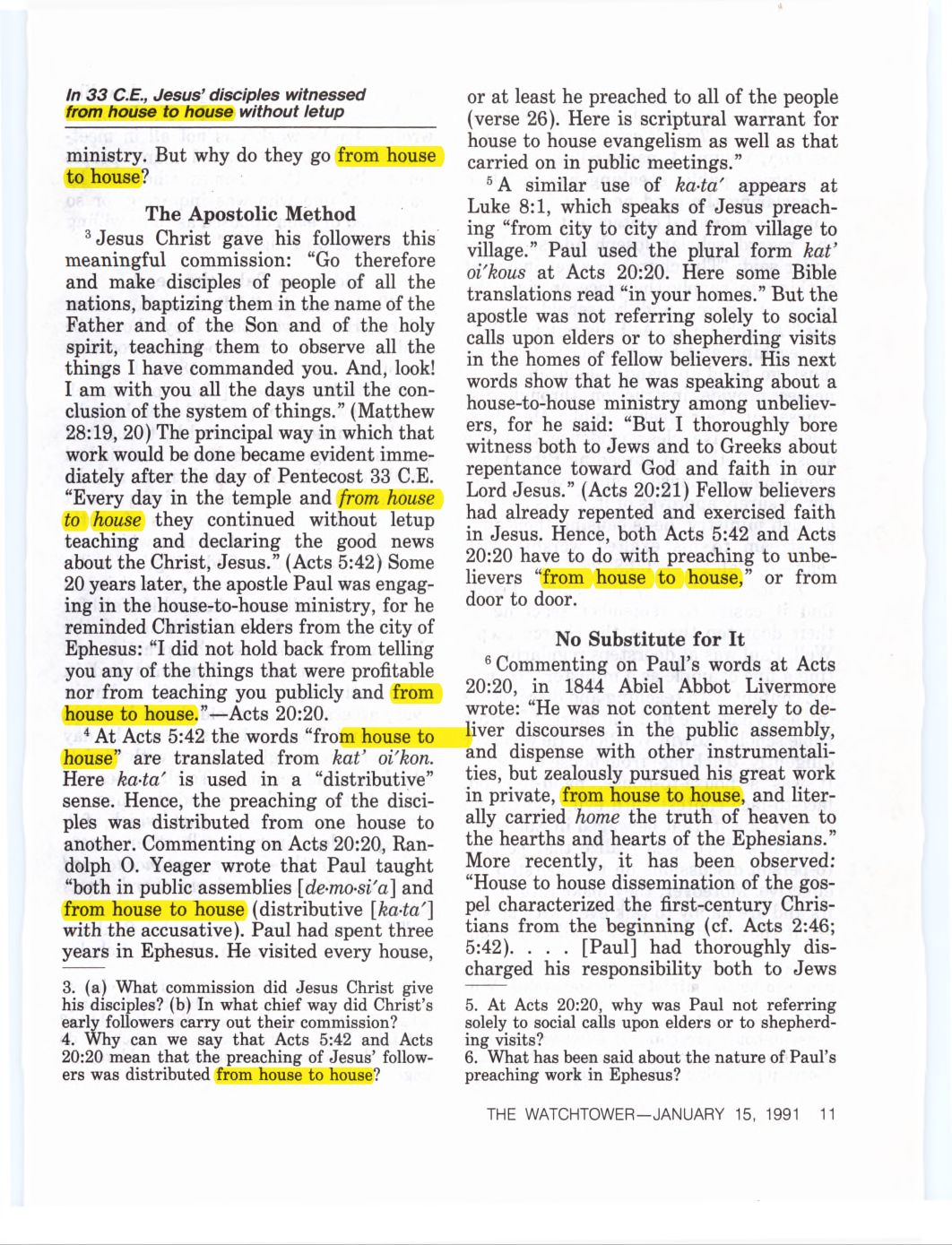
The organization grounds the house-to-house ministry in scripture, principally the apostle Paul's statement, in the book of Acts, that he taught "publicly and from house to house," and Jesus' command to "make disciples of people of all the nations." It presents door-to-door work as the apostolic method carried into the present, and calls it the religion's "trademark."[4][8] Above all it ties the work to a prophecy in Matthew's Gospel — that "this good news of the Kingdom will be preached in all the inhabited earth ... and then the end will come" — which casts evangelism not as optional but as urgent, a precondition of the world's promised conclusion.[8]
That conviction is wired into the religion's structure through a word: publisher. Every active Witness is a publisher — a member who preaches — and every publisher files a monthly report on their ministry. Those reports flow upward, from congregation to branch to world headquarters, and are tallied each year into a vast public ledger the organization calls the Grand Totals: the worldwide counts of publishers, hours spent preaching, Bible studies conducted, and attendance at the annual Memorial. The system of reporting time dates to 1920, and for more than a century it made the Witnesses perhaps the most meticulously self-quantified religion on earth.[1][5] The scale of the accounting is striking: in its 2022 report alone the organization tallied some 8.7 million publishers across 239 lands, nearly 118,000 congregations, more than 1.5 billion hours of preaching, and almost 20 million people at its annual Memorial.[5] To be a Witness in good standing was, in part, to be counted.
Unprecedented — with a caveat
The 2020 suspension was widely described as the first time the door-to-door work had ever stopped, and that is very nearly true — but the precise version is more interesting than the headline.
The religion had endured disruptions before. During the 1918 influenza pandemic, the work fell to a near standstill — but largely because the movement's leaders had been imprisoned, an external blow rather than a chosen pause. Under the Nazi regime and in the Soviet Union, Witnesses defied outright bans to keep preaching. What made March 2020 genuinely without precedent, as the scholar of religion George Chryssides has noted, was that this was the first time the organization itself directed a worldwide halt to its public ministry.[6] The Witnesses had been stopped before; they had never, until COVID-19, stopped themselves.
A ministry by mail
The doors closed, but the work did not. It changed shape.
With public witnessing suspended, Witnesses turned to letters, telephone calls, and Bible studies conducted over video. The pivot was substantial: Chryssides documented a roughly 40 percent jump in visitors to the organization's website in March 2020, and a spike in online Bible-study requests — on the order of a thousand in the 48 hours surrounding the 2020 Memorial, against a normal rate closer to 250 a day. The Memorial itself, the religion's most important annual event, was held over video conference for the first time.[6] For a religion built on face-to-face contact, the months of letter-writing and phone calls were a genuine reinvention of method — one that would outlast the emergency that produced it.
The hybrid return
The return came in stages, each announced in advance to congregations worldwide. Kingdom Halls reopened for in-person meetings on April 1, 2022. Public cart witnessing — the staffing of literature carts in stations and squares — resumed on May 31. And on September 1, 2022, after roughly two and a half years, Jehovah's Witnesses knocked on strangers' doors again.[3]
But the old methods did not simply switch back on while the pandemic improvisations switched off. They layered. Door-to-door work returned alongside the letter-writing, the phone calls, and the virtual studies that the shutdown had forced into being — a hybrid ministry rather than a clean reversion to 2019. Robert Hendriks, then the religion's U.S. spokesman, framed the return to the doors as a matter of conviction, calling it "an expression of our God's impartiality" — the principle that the message goes to everyone, who may then accept or refuse it.[3] He acknowledged, too, that knocking on strangers' doors again after so long would take "an additional level of courage." The result was that the pandemic channels did not vanish; they stayed, folded in beside the doorstep work, and the hybrid became less a transitional phase than the new ordinary.[3]
The number that disappeared
The more consequential change came not from the pandemic but from a decision announced the following year — and it is the one most likely to endure.
On October 7, 2023, at the annual meeting of the religion's Pennsylvania corporation, the Witnesses announced that rank-and-file publishers would, as of November 1, no longer report the number of hours they spent preaching. They would report only whether they had shared in the ministry at all that month. Only full-time pioneers would continue to log hours.[1] It was the end of a practice that had defined the religion for 103 years.
"Our ministry involves much more than counting time," the Governing Body member Samuel Herd said in announcing the change.[1] The shift was visible in the ledger itself: the 2024 Grand Totals — the first annual report to reflect the new policy — dropped the line for "Total Hours Spent in Field" that had appeared for generations. The prior year's report had still carried it; the 2024 edition simply omitted it.[5]
What the numbers, and their absence, might mean
The organization was quick to head off a particular reading of the change — that it was hiding decline. A spokesman, Jarrod Lopes, pointed out that preaching hours had been rising, "from 1.4 billion in 2021 to 1.5 billion hours in 2022," not falling.[1] By the religion's own reports, membership has continued to grow: the worldwide peak of publishers rose from about 8.7 million in 2022 and 2023 to more than 9 million in 2024, annual increases the organization reported at roughly 0.4, 1.3, and 2.4 percent.[5]
Yet outside observers saw something larger at work. Mathew Schmalz, a professor of religious studies, described the move as "a relaxation of the sectarian identity of the group" — a step toward looking like a conventional religious organization rather than a metrics-driven sect, even as the group wants the public to take it seriously as a faith.[2] Former members were blunter still. One ex-elder called it "one of the biggest changes I ever remember," and recalled what the tally had meant inside the religion: "It showed you how loyal you were to Jehovah by how much time was put in."[1] And critics note the obvious analytic effect: a religion that stops publishing how many hours it spends to win each new member also stops making its efficiency — and any decline in it — easy for outsiders to track.
That tension sits unresolved, which is the honest place to leave it. Among the population raised in the religion, the Pew Research Center has found one of the lowest retention rates it measures — only about a third still identify as Witnesses in adulthood — even as the same research found America's Witnesses to be among its most racially diverse religious communities.[7] A faith that built its identity on counting has, for now, decided to count less. Whether that reflects confidence or concern is a question the surviving numbers no longer answer.
Sources
- NewsAssociated Press (Peter Smith), "Timekeepers no more: Rank-and-file Jehovah's Witnesses say goodbye to tracking proselytizing hours," November 2023 (via NBC News) https://www.nbcnews.com/news/religion/timekeepers-no-rank-file-jehovahs-witnesses-say-goodbye-tracking-prose-rcna126582
- NewsFortune, "Jehovah's Witnesses drop a longtime requirement to report preaching hours," November 2023 https://fortune.com/2023/11/22/jehovahs-witnesses-preaching-metrics-policy-change/
- NewsNPR / Associated Press, "Jehovah's Witnesses resume door-to-door ministry after a 2-year pandemic pause," September 2, 2022 https://www.npr.org/2022/09/02/1120738987/
- PrimaryThe Watchtower, January 15, 1991, "Teach Publicly and From House to House," p.43 View scanned page →
- NewsJehovah's Witnesses, annual Service Year Reports / Grand Totals, 2022–2024 (jw.org) — a party source for self-reported figures https://www.jw.org/en/library/books/2024-Service-Year-Report-of-Jehovahs-Witnesses-Worldwide/2024-Grand-Totals/
- NewsGeorge D. Chryssides, "Jehovah's Witnesses and Covid-19," CenSAMM https://censamm.org/blog/jehovahs-witnesses-and-covid
- PrimaryPew Research Center, "A closer look at Jehovah's Witnesses living in the U.S." (2016) https://www.pewresearch.org/short-reads/2016/04/26/a-closer-look-at-jehovahs-witnesses-living-in-the-u-s/
- News"The House-to-House Ministry—Why Important Now?" The Watchtower (jw.org) — a party source https://www.jw.org/en/library/magazines/w20080715/The-House-to-House-Ministry-Why-Important-Now/
Corrections: If you believe any factual statement here is inaccurate, please contact us. JW Files publishes corrections at the top of the original article and maintains a public corrections log.
Editorial note: This is a neutral news summary. Historical context, where present, is grounded in the Watchtower's own publications, shown as primary-source page images. Any interpretation lives in the separately-labeled editorial.