A Jehovah's Witnesses leader testified under oath in 2015. Here is what he said.
Geoffrey Jackson, a member of the Governing Body that runs Jehovah's Witnesses worldwide, gave sworn evidence to Australia's Royal Commission — on the group's claim to speak for God, the two-witness rule, and whether women could judge abuse cases.
On August 14, 2015, a member of the small body that sets doctrine for Jehovah's Witnesses worldwide did something almost without precedent: he answered questions under oath. Geoffrey Jackson, one of the then-seven men on the Governing Body, testified by video link to Australia's Royal Commission into Institutional Responses to Child Sexual Abuse — the most senior Jehovah's Witnesses leader ever to give evidence to such an inquiry.[1][3]
He had not planned to. Jackson was in Australia visiting his ailing father when the Commission, examining the organization's handling of abuse, called him to testify.[1]
The Governing Body
To understand why his evidence mattered, an outsider needs to know what the Governing Body is. It is a small group of men, headquartered in New York, that sets doctrine, policy, and procedure for Jehovah's Witnesses everywhere. Its authority is total within the religion and entirely centralized: the organization's national branches cannot adopt or change policy without its approval. That centralization was itself relevant to the inquiry, because it meant the Witnesses' way of handling abuse was not a local quirk but a worldwide policy set at the top. The Governing Body's members are not chosen by the membership and do not answer to it; they understand themselves to be appointed under the direction of holy spirit.[2]
Witnesses understand the Governing Body to be the "faithful and discreet slave" of a Gospel parable — a role the organization narrowed, in a 2012 doctrinal revision, to the Governing Body alone — and God's channel of communication to humankind in the present day.[2] It was that self-understanding, more than any single fact about a case, that the most-quoted exchange of the day put to the test.
Speaking for God
The most striking exchange concerned that very authority. The organization's literature urges members never to challenge "the channel of communication that Jehovah is using today."[2] Asked whether the Governing Body considered itself the sole spokesman for God on earth, Jackson stepped back from the claim: "That, I think, would seem to be quite presumptuous, to say that we are the only spokesperson that God is using," he testified.[1] The answer drew notice precisely because it sat at an angle to the organization's published teaching about its own role. For a body that instructs its members to accept its direction as coming from God, a disavowal of being God's sole spokesman — offered under oath, in a courtroom — was a notable thing to say. It is the kind of distinction that reads one way in a legal proceeding and another in a Kingdom Hall.
The two-witness rule
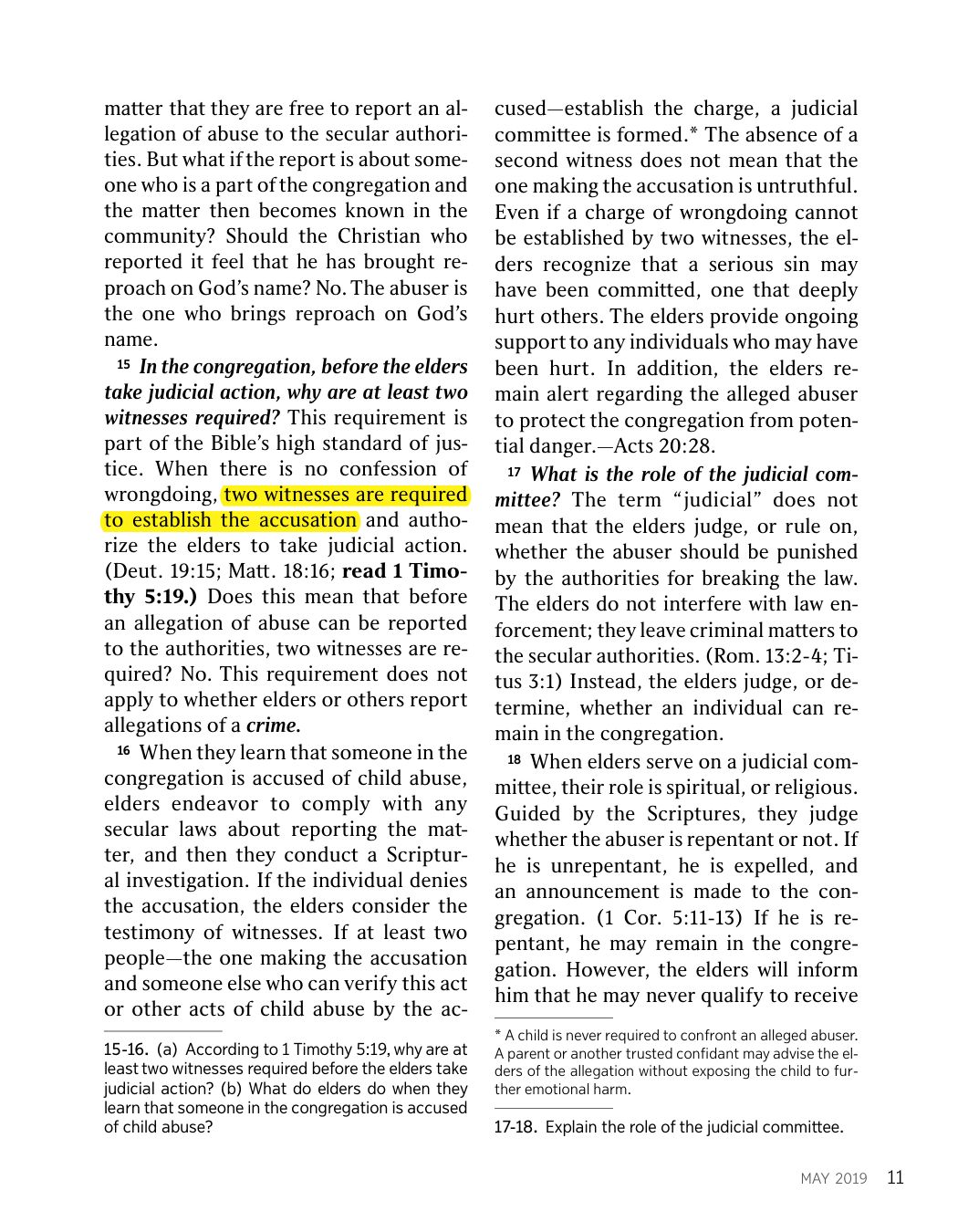
Counsel assisting the Commission pressed Jackson on the rule requiring two witnesses before elders may act on an abuse accusation, posing a scriptural hypothetical — whether Jesus, asked about such a case, might not have set the two-witness requirement aside. Jackson said he would "certainly like to ask Jesus that," but could not, and called it a hypothetical question.[1]
The exchange went to the foundation of the rule. The Witnesses derive the two-witness requirement from passages in Deuteronomy and the Gospel of Matthew, and apply it to internal accusations of serious wrongdoing, including abuse. Counsel's point was that the same scriptures, read differently, need not bar elders from acting on a single child's account — that the rule was a choice of interpretation, not an unavoidable command. Jackson's response left the rule, and its consequences for children who could produce no second witness, where they stood.
Women and the committees
The chair of the Commission, Justice Peter McClellan, asked whether women could take part in deciding whether an abuse allegation was true. When Jackson began to say women were already involved, McClellan pressed him: "Not in the decision, Mr Jackson. Please address my question." Jackson's answer was that, in the organization's reading of scripture, "the role of judge in the congregation lays with men."[1]
The exchange laid bare a structural feature of how the Witnesses handle abuse: the panel that decides whether a child's allegation is credible is, by doctrine, composed only of men. For a girl reporting that she had been abused, that meant recounting it to a committee of male elders, with no woman among those weighing her word. It was one of the practices the Commission would single out for change.
Could the policy change?
Jackson indicated that the organization would comply with mandatory-reporting laws where they applied, and suggested it was willing to consider changes to how it dealt with such cases.[1] That testimony bore directly on a question at the center of the inquiry: whether the Witnesses' practice of keeping abuse allegations inside the congregation was a fixed scriptural command or a discretionary policy that could be revised. The distinction carried consequences. If the practice could be changed, the Commission's reasoning ran, then the organization bore responsibility for having maintained it — and a Governing Body member's acknowledgment that change was possible undercut any claim that scripture had tied the organization's hands.[1]
Aftermath
The Commission's final report, published in October 2016, recommended that the organization stop applying the two-witness rule in child-abuse cases, involve women in investigations, and cease shunning those who leave the religion after being abused. It concluded that so long as the Witnesses relied on a literal interpretation of the Bible and first-century principles to set practice and policy, the organization would "remain an organisation that does not respond adequately to child sexual abuse."[1]
Jackson's appearance was, in its way, historic. The Governing Body almost never submits to outside questioning; its authority within the religion rests on the premise that it answers to God, not to courts or critics. For one of its members to sit for hours of cross-examination — to grant that claiming to be God's sole spokesman would be "presumptuous," that the two-witness rule was a matter of interpretation, that the organization's handling of abuse could change — was to expose the human deliberation behind doctrine the faithful are taught to receive as divine direction. Whether that exposure changed anything was a separate question. The two-witness rule, the practice he had defended, would remain in force for years to come.
Sources
- NewsRoyal Commission into Institutional Responses to Child Sexual Abuse (Australia), Case Study 29, Day 155 transcript — testimony of Geoffrey Jackson, 14 August 2015 https://www.childabuseroyalcommission.gov.au/case-studies/case-study-29-jehovahs-witnesses
- NewsJehovah's Witnesses publications on the Governing Body as the "faithful and discreet slave" / God's channel of communication (jw.org) — a party source https://www.jw.org/en/jehovahs-witnesses/faq/jehovahs-witnesses-governing-body/
- NewsBBC News, contemporaneous coverage of the Royal Commission's Case Study 29 hearings (2015) https://www.bbc.com/news/world-australia-33673240
- PrimaryThe Watchtower (study edition), May 2019, p.11 View scanned page →
Corrections: If you believe any factual statement here is inaccurate, please contact us. JW Files publishes corrections at the top of the original article and maintains a public corrections log.
Editorial note: This is a neutral news summary. Historical context, where present, is grounded in the Watchtower's own publications, shown as primary-source page images. Any interpretation lives in the separately-labeled editorial.