Jehovah's Witnesses stopped saying "disfellowshipped." What actually changed?

A 2024 change retired the word "disfellowshipping" for "removed from the congregation" and eased a single rule about greeting former members. But the announcement, the no-socializing, and the shunning of critics all remained — and the change arrived just as the practice faced its sharpest legal test in Europe.
In 2024, Jehovah's Witnesses retired one of their most recognizable words. For more than seventy years, a member expelled from the congregation had been "disfellowshipped" — a term so distinctive that it had passed into general English as a byword for religious shunning. In a study article in its August 2024 Watchtower, the organization announced that it would use the word no longer. Expelled members would now be called "removed from the congregation."[1]
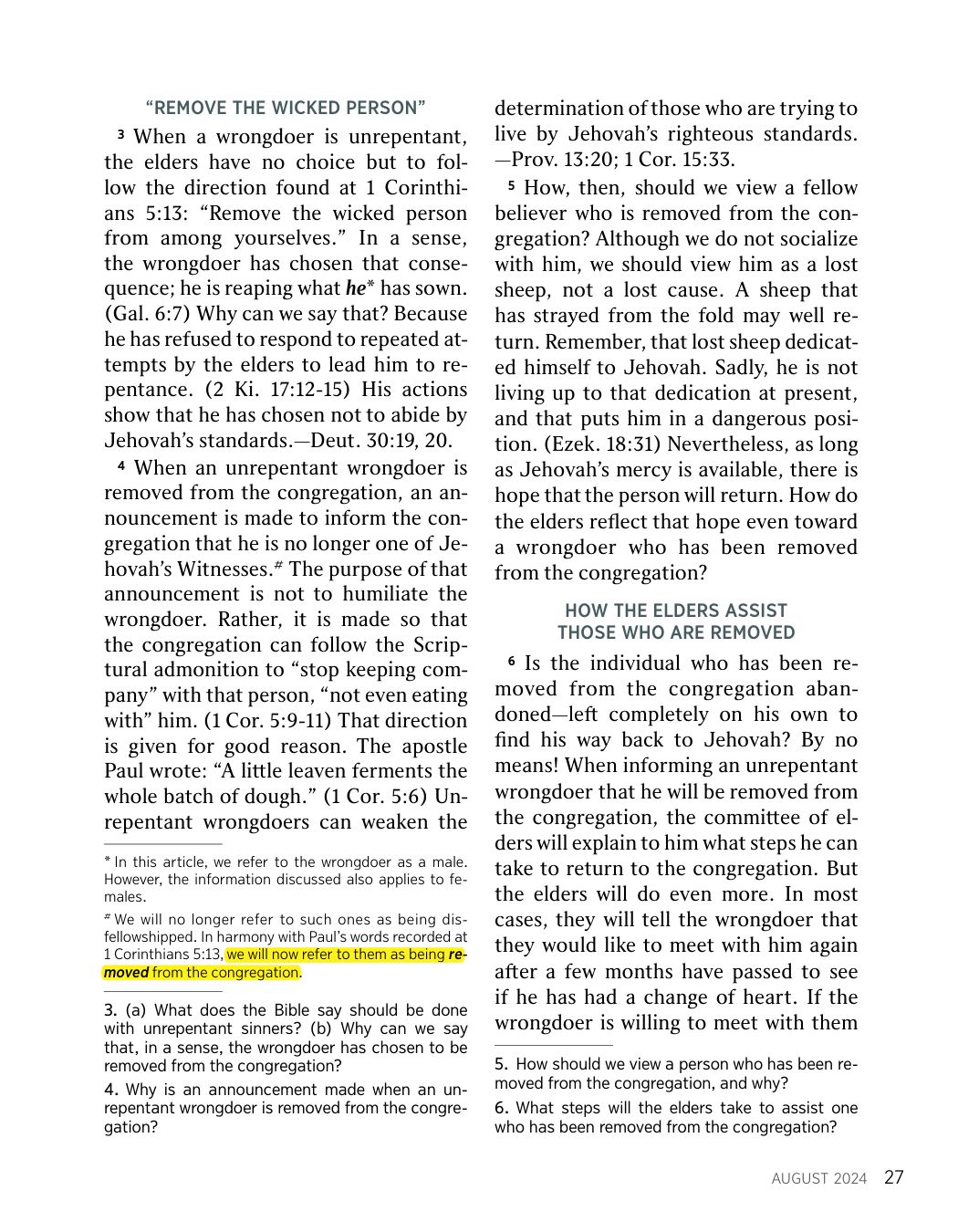
The change, which the article tied to the apostle Paul's instruction at 1 Corinthians 5:13 to "remove the wicked man from among yourselves," came paired with a second, subtler adjustment: a small relaxation of the rule governing how Witnesses may treat those who have been removed.[1] In the weeks that followed, some coverage framed the news as Jehovah's Witnesses softening — or even ending — their practice of shunning.
That reading is mistaken, and the organization's own text is the best evidence of why. What changed in 2024 was a name and a narrow point of etiquette. What did not change was shunning itself. Seeing the difference clearly — and understanding why a wording change in a religious magazine drew international notice at all — requires three things: knowing what shunning is, how the Witnesses built it over seven decades, and the legal pressure now bearing down on it across Europe.
What shunning is
Among Jehovah's Witnesses, expulsion is not merely a loss of membership. It triggers a comprehensive social severing that the religion regards as scripturally commanded.
When elders remove someone, an announcement is made to the congregation. From that point, other members are to "stop keeping company" with the person. The 2024 article states the rationale in the organization's own words: "The purpose of that announcement is not to humiliate the wrongdoer. Rather, it is made so that the congregation can follow the Scriptural admonition to 'stop keeping company' with that person, 'not even eating with' him."[1] The instruction reaches into families: a removed relative living outside the immediate household is to be contacted only for necessary matters.[2] Because many lifelong Witnesses have built their entire social world inside the congregation, removal can sever, at once, nearly all of a person's friendships and much of their ordinary contact with relatives who remain.
The Witnesses ground the practice in three passages of scripture, and the readings matter because each does distinct work. From 1 Corinthians 5 — where Paul tells a congregation to "remove the wicked man from among yourselves" and to "stop keeping company" with an unrepentant wrongdoer — comes the core of expulsion and avoidance. From the second letter of John comes the sharpest edge: the instruction not to receive certain people "into your homes" or even to "say a greeting" to them, on the reasoning that "the one who says a greeting to him is a sharer in his wicked works."[4] And from Matthew 18, where Jesus describes telling an unrepentant offense "to the congregation," comes the procedural model of escalating warnings. Taken together, the Witnesses read these texts as requiring not estrangement of feeling but a deliberate, communal withdrawal of fellowship.
Seventy years in the making
Shunning in something close to its present form has been Witness practice for generations, but its modern shape was set by a series of hardenings across the second half of the twentieth century.
The pivotal one came in 1981. Until then, the religion drew a distinction between two kinds of departure: members expelled for wrongdoing (the "disfellowshipped") and members who formally renounced the faith of their own accord (the "disassociated"). In 1981 the organization collapsed that distinction, directing that those who voluntarily left be shunned exactly as those who were expelled. The shift is documented in an unlikely place — a 1987 opinion of the United States Court of Appeals for the Ninth Circuit, in a lawsuit brought by a former member who had been shunned after she left. The court summarized the change plainly: "the distinction between disfellowshiped and disassociated persons was, for all practical purposes, abolished," and disassociated persons "were to be treated in the same manner as the disfellowshiped."[6]
That case is also a reminder of how durably the practice has withstood legal challenge in the United States. The Ninth Circuit ruled against the former member, holding that the church's shunning was a constitutionally protected religious activity for which it could not be sued.[6] The detailed mechanics of the modern process — who sits on the committees that remove members, how reinstatement works, what conduct is covered — are set out in a confidential manual issued to elders, Shepherd the Flock of God, first distributed in 2010 and revised several times since.[1] Removal is decided by a committee of elders; a person who has been removed may later petition for reinstatement, which requires the elders' judgment that the individual has genuinely repented.[1]
What changed in 2024 — and what didn't
Against that history, the 2024 changes are best understood by sorting them into three piles: what changed, what stayed, and what, for one category of people, actually got firmer.
What changed. Two things. The vocabulary — "removed" replaces "disfellowshipped." And one practice: a Witness may now, as a matter of personal conscience, extend a simple greeting to a removed person, or invite them to a meeting. That reverses a notably strict prior rule. "In the past, we would not greet such a person," the 2024 article acknowledges; now, "some may feel comfortable with greeting or welcoming the person to the meeting."[1]
What stayed. Almost everything else. The congregation announcement remains. The core instruction — "stop keeping company," "not even eating with" the person — remains, and the 2024 article restates it. Even the new greeting latitude is fenced: "we would not have an extended conversation or socialize with the individual," the same paragraph continues.[1] A removed person may now be nodded to; they are still not to be befriended, hosted, or treated as a member of the community.
What got firmer. For one category, the rule tightened rather than loosened. The greeting relaxation explicitly does not apply to those the organization classifies as apostates — people who, in its words, "actively promote wrong conduct" or oppose the religion. As to them, the 2024 article is unambiguous: "we would neither greet such a person nor invite him to attend a congregation meeting."[1] The softer treatment of ordinary removed members thus runs alongside a continued, pointed exclusion of those who criticize the faith.
The net effect, then, is real but bounded: a change of name and a humane-sounding easing at the margin, set inside a practice of shunning that the same article reaffirms at length. It is not the end of shunning, and the organization did not present it as one.
The shadow of the courtroom
If the change was modest, its timing was striking — and that is the part outside observers have seized on.
The announcement did not arrive in a vacuum. The wording change had been previewed weeks earlier, in a Governing Body video update in March 2024 built around the theme that God "desires all to attain to repentance."[5] And across Europe, the Witnesses' shunning practice had become a legal liability. In Norway, the state had moved to strip the religion of its registration and its public funding specifically over shunning, and in March 2024 — within days of that video — an Oslo court upheld the state's action. (The decision was later reversed on appeal and, in 2026, at Norway's Supreme Court.) In Belgium, the organization had been criminally convicted in 2021 over its shunning instruction before that conviction was overturned on appeal in 2022 and the acquittal affirmed in 2023.[3][8]
The scrutiny has not been only European. Australia's Royal Commission into Institutional Responses to Child Sexual Abuse, which examined the Witnesses in 2015, identified the threat of shunning as a force that could discourage abuse victims within the religion from coming forward — since stepping outside the congregation for help can itself be treated as disloyalty.[7]
Specialist coverage drew the obvious inference cautiously. The Christian news outlet CNE noted that "the new measures have been introduced with unusual haste," and quoted a lawyer who is himself a Witness saying it was difficult not to see a connection to the Oslo decision.[3] The organization itself has not said that litigation prompted the change, and the inference — however natural — remains an inference. It belongs to observers, not to the Witnesses' own account of why they acted.
How to weigh it
One last feature of this story is worth stating plainly, because it shapes how confidently anyone can characterize it: the change was almost entirely reported by the organization itself and by a handful of specialist and ex-member outlets. No major wire service appears to have covered the renaming. The primary evidence is the Watchtower article — which is why this account leans so heavily on quoting it directly.
Read against that text, two interpretations coexist. To critics, the move is cosmetic — a softer label and a token concession arriving precisely when the practice faced its sharpest legal scrutiny in Europe. To the organization, it is a measured act of compassion toward the removed, consistent with scripture. Both readings are defensible; neither is this desk's to certify. What is not in dispute is the day-to-day reality for someone removed from a congregation: an announcement to the people they worship with, and a community instructed, with one new and narrow exception, to keep its distance.
Sources
- PrimaryThe Watchtower (study edition), August 2024, "Help for Those Who Are Removed From the Congregation," pp.26–31 View scanned page →
- NewsJehovah's Witnesses, "How Do Jehovah's Witnesses View Those Who Are Removed?" (jw.org FAQ) — a party source https://www.jw.org/en/jehovahs-witnesses/faq/removed-from-the-congregation/
- NewsEvert van Vlastuin, "Jehovah's Witnesses ease shunning rules after blow in Oslo court," CNE.news, 24 April 2024 https://cne.news/article/4220-jehovahs-witnesses-ease-shunning-rules-after-blow-in-oslo-court
- News"How to Treat a Disfellowshipped Person," God's Love book (jw.org), applying 2 John 9–11 — a party source https://www.jw.org/en/library/books/gods-love/disfellowshipped-person/
- NewsJehovah's Witnesses, 2024 Governing Body Update No. 2 (jw.org) — a party source https://www.jw.org/en/news/region/global/2024-Governing-Body-Update-2/
- PrimaryPaul v. Watchtower Bible and Tract Society of New York, 819 F.2d 875 (9th Cir. 1987) https://law.justia.com/cases/federal/appellate-courts/F2/819/875/
- PrimaryRoyal Commission into Institutional Responses to Child Sexual Abuse (Australia), Case Study 29: Jehovah's Witnesses (2015–2016) https://www.childabuseroyalcommission.gov.au/case-studies/case-study-29-jehovahs-witnesses
- NewsBitter Winter / Human Rights Without Frontiers, reporting on the Belgium (Ghent) shunning case, 2021–2023 https://bitterwinter.org/the-ghent-saga-ends-belgium-cassation-court-confirms-that-shunning-is-lawful/
Corrections: If you believe any factual statement here is inaccurate, please contact us. JW Files publishes corrections at the top of the original article and maintains a public corrections log.
Editorial note: This is a neutral news summary. Historical context, where present, is grounded in the Watchtower's own publications, shown as primary-source page images. Any interpretation lives in the separately-labeled editorial.