A San Diego court hit the Watchtower with a $13.5 million judgment — over records it would not produce

In 2014 a judge entered a default judgment against the organization for refusing to hand over its internal child-abuse files. An appeals court reversed it in 2016 — but the fight over those records would recur for years.
In October 2014, a San Diego judge entered a default judgment of about $13.5 million against the Watchtower Bible and Tract Society — and the immediate reason was not the abuse at the heart of the lawsuit. It was paper. The organization had refused to hand over internal records about child sexual abuse that the court had ordered it to produce, and the judgment was the court's sanction for that refusal.[1][2]
The judgment did not survive. In April 2016, a California appeals court reversed it — not because the Watchtower had behaved well, but because the trial judge had reached for the harshest available sanction without first trying milder ones.[1] The case later settled on confidential terms.[1] The headline figure never stood. But the fight that produced it — over a single 1997 letter and the records it generated — would recur in courtroom after courtroom for the next decade.
The case
Jose Lopez sued the Watchtower as an adult, alleging he had been sexually abused as a child, around the age of seven, by a member of his San Diego congregation, Gonzalo Campos.[1] The chronology laid out in the appellate opinion is part of what made the case potent. Campos was alleged to have abused at least eight Witness children across more than a decade, beginning in the early 1980s. The organization appointed him a ministerial servant later that decade, and — by the court's account — approved his promotion to elder in 1993, after the period in which Lopez was abused.[1] By the opinion's account, a man later accused of molesting children inside the congregation had been advanced within it.
The case never reached a jury on those facts. It foundered earlier, on discovery — the pre-trial stage in which each side must hand over relevant documents. And what Lopez's lawyers wanted, the Watchtower would not give.
The 1997 letter and the database
Central to Lopez's case was a document the Watchtower did not want to produce: a letter dated March 14, 1997, sent to all bodies of elders in the United States. By the court's account, it directed elders who learned that a member was known to have committed child molestation to report the matter up to the organization's headquarters.[1] Those reports, investigative journalists later documented, were gathered at the Watchtower's New York offices — mailed in special blue envelopes and kept in a centralized file the elders were instructed not to destroy.[3] One reporting project described the result as something like a national survey of abuse, built question by question from the congregations up.[3] In 2014, a Watchtower official acknowledged under oath that such a database existed.[3]
Lopez sought the records generated by that 1997 directive — the organization's accumulated knowledge of abuse allegations across its U.S. congregations. The Watchtower refused, invoking clergy-penitent privilege, attorney-client privilege, the privacy of third parties, the First Amendment, and the sheer burden of the search, which it argued could take a single worker nearly two decades to complete across nearly 14,000 congregations.[1] The refusal, not the abuse, became the central dispute — and the same dispute would recur in case after case.
Why a default — and why it didn't hold
The trial court was unpersuaded. It found the Watchtower's non-compliance with its production orders "willful," and said it could find no evidence the organization had even attempted to locate the documents.[1] As a sanction, the court struck the Watchtower's defense and entered the roughly $13.5 million default judgment, most of it punitive.[2]
That is where the case became a lesson in procedure. The California Court of Appeal reversed in April 2016 on a narrow ground: the trial judge had imposed a terminating sanction — the most drastic option — as the first and only one, without first attempting lesser measures to compel compliance.[1] The default was vacated, the case remanded, and it ultimately settled in confidence.[1] What the appellate court did not do was excuse the organization's conduct; it found the procedure flawed, not the underlying refusal justified.
The policies underneath
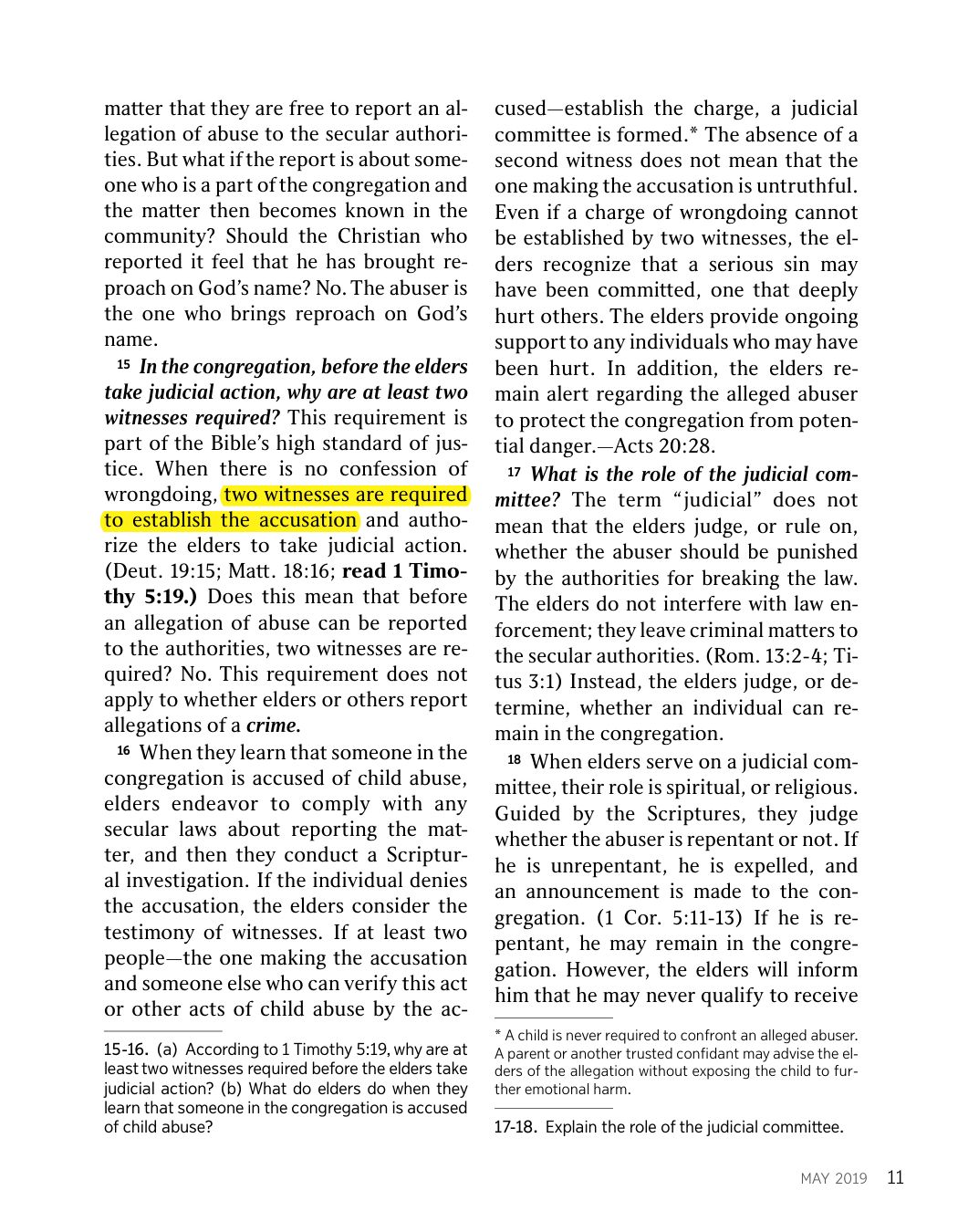
Two features of the organization's internal handling recur across these cases. The first is the two-witness rule — the requirement, drawn from scripture, that an accusation of serious wrongdoing be established by a second witness or a confession before elders take action. The Watchtower states it in its own publications: when there is no confession, "two witnesses are required to establish the accusation and authorize the elders to take judicial action."[4]
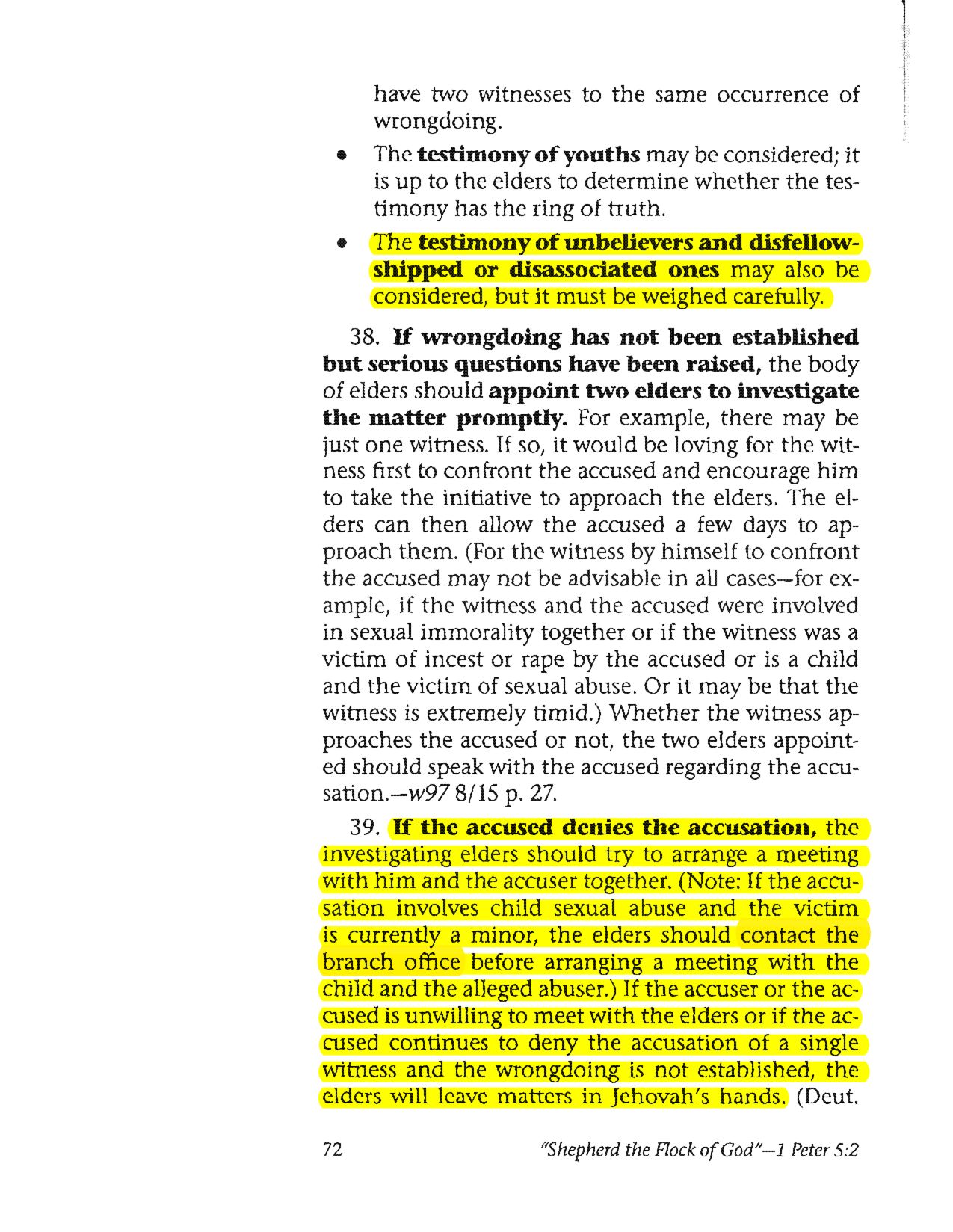
The second is the instruction that elders telephone the organization before responding to an abuse report. The elders' manual directs them to "contact the branch office" before proceeding where a child is involved.[5]
The organization maintains that these practices govern internal religious discipline, not whether a crime is reported to the police, and it says it "abhors child abuse." Responding to the Lopez judgment, its associate general counsel called the sanction "a drastic action for any judge to take."[6]
The wider pattern
Lopez was the first of a series, not an isolated dispute. In a parallel San Diego case, Padron v. Watchtower, a court imposed coercive sanctions of $4,000 a day over the same refusal to produce the 1997-era records — $2,000 for each day the organization failed to search, and $2,000 more for each day it failed to produce. The appeals court noted that the Watchtower could not even object to the daily penalty, because in Lopez it had itself argued for exactly that kind of monetary sanction in place of a terminating one.[7] Its own litigation strategy had boxed it in.
The thread ran on. In a Montana federal case years later, a judge ordered an adverse-inference instruction — telling the jury it could assume the worst — after finding the organization had destroyed records summarizing abuse data held in its New York archives; the Witnesses' chief lawyer was personally sanctioned over false affidavits, a penalty an appeals court upheld, and the cases settled confidentially in 2024.[8]
Across all of them runs the same object: the 1997 letter and the database it built, and the organization's resistance to disclosing either. The dispute recurs case after case in the discovery phase, long before any jury hears the underlying facts. The Watchtower says it abhors child abuse; in court, much of this litigation has turned not on that question but on access to the records the organization itself compiled.
Sources
- NewsLopez v. Watchtower Bible and Tract Society of New York, D066388, 246 Cal.App.4th 566 (Cal. Ct. App. 2016) https://www4.courts.ca.gov/opinions/archive/D066388.DOC
- NewsNBC 7 San Diego, coverage of the 2014 default judgment https://www.nbcsandiego.com/news/local/135m-awarded-to-bible-teacher-gonzalo-campos-alleged-abuse-victim-jose-lopez/62352/
- NewsThe Daily Beast, reporting on the Watchtower abuse database (based on Reveal / Center for Investigative Reporting) https://www.thedailybeast.com/the-secret-database-of-jehovahs-witness-child-abusers/
- PrimaryThe Watchtower (study edition), May 2019, p.11 View scanned page →
- PrimaryShepherd the Flock of God (2010 elders' manual), p.75 View scanned page →
- NewsChristian Post, statement of Watchtower associate general counsel Mario Moreno https://www.christianpost.com/news/jehovahs-witnesses-hit-with-another-lawsuit-alleging-child-sexual-abuse-organization-has-paid-over-13-million-in-damages-130490
- NewsCoverage of Padron v. Watchtower and the $4,000/day sanctions (Cal. Ct. App., 2017) https://zapproved.com/blog/court-rejects-churchs-appeal/
- NewsCoverage of the Caekaert/Mapley federal case and the spoliation sanctions (D. Mont.) https://www.jwchildabuse.org/news/jehovahs-witnesses-settle-historic-child-abuse-cases-in-federal-court/
Corrections: If you believe any factual statement here is inaccurate, please contact us. JW Files publishes corrections at the top of the original article and maintains a public corrections log.
Editorial note: This is a neutral news summary. Historical context, where present, is grounded in the Watchtower's own publications, shown as primary-source page images. Any interpretation lives in the separately-labeled editorial.